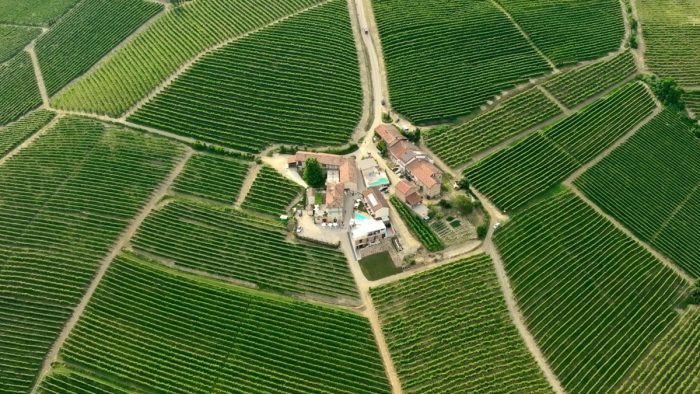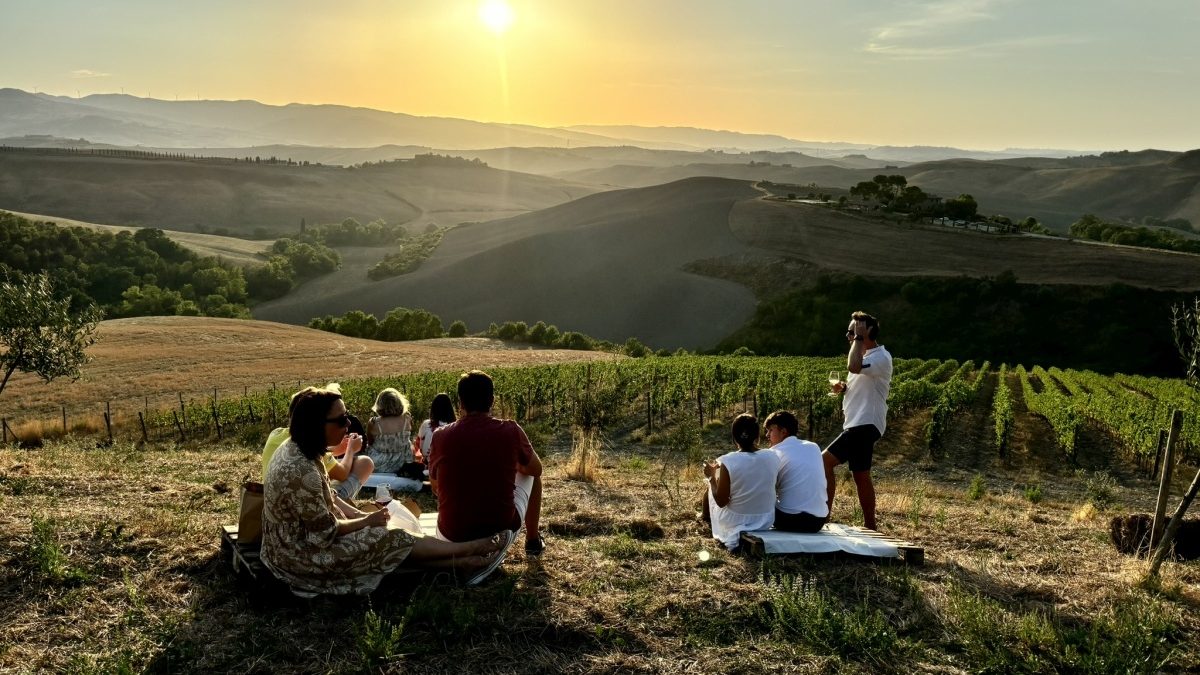
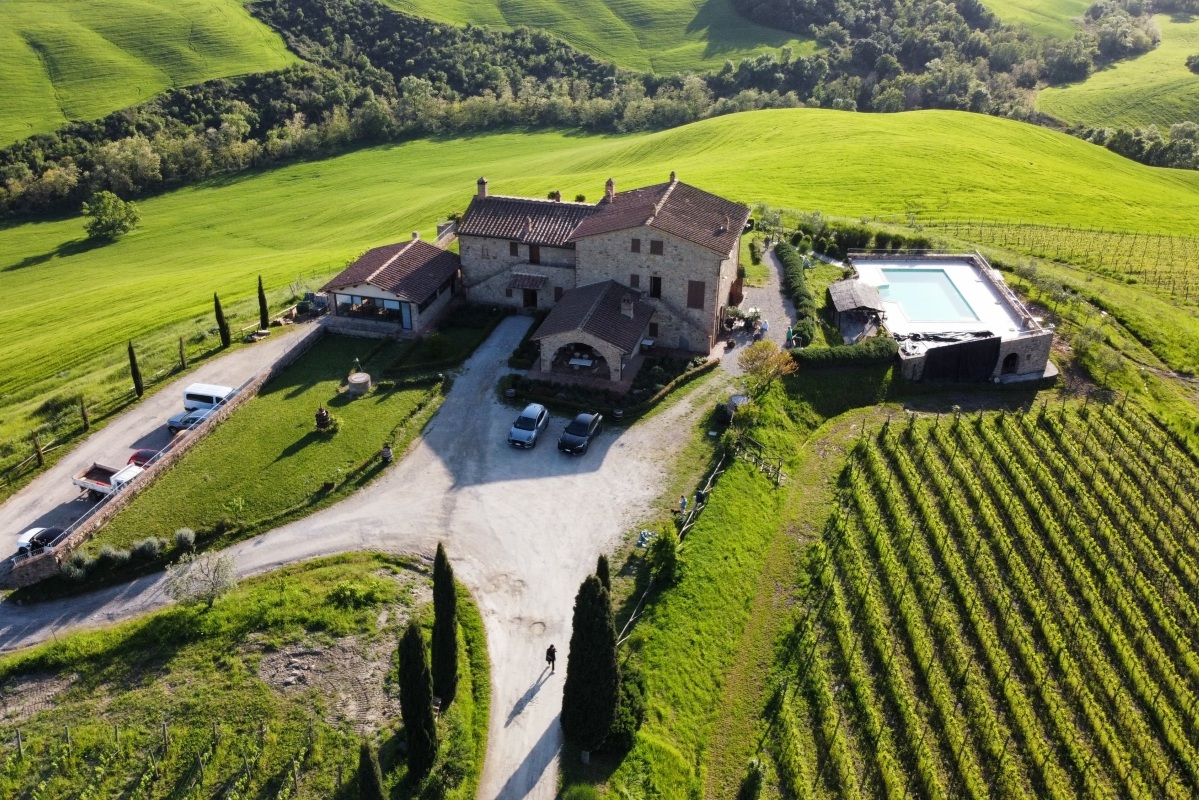
A hillside overlooking the Val di Cecina plain, with the Balze di Volterra behind it. Here in 2003 Genuino Del Duca and Ivana Delli Compagni purchased a ruin and launched a project the company itself describes as «ambitious and perhaps even pioneering»: to produce wine on the hills of Volterra, in a territory that today is opening up to the national wine scene. They came from the restaurant business. First a venue in Saline di Volterra, then after about ten years, the Enoteca Del Duca downtown, just steps from Piazza dei Priori, run for about thirty years. In 2003 they sold the Saline restaurant and began building Podere Marcampo.
MERLOT ON BLUE MARL
Before construction even began, Genuino had the soils analyzed. They are sedimentary soils rich in marine deposits and bluish clayey marls, with good permeability and excellent drought resistance; the roots spread not too deeply and the plant grows slowly and gradually. The first choice was merlot, so it could mature without ripening too early.
Along with the restoration of the ruin, which became a main house with agritourism, swimming pool and winery, the first vineyards were planted: about two hectares between 140 and 245 meters above sea level. With the new vineyards planted in 2017 the company reached 5 hectares, all adjacent to the winery, divided between merlot, sangiovese, pugnitello, ciliegiolo and vermentino. Organic certification arrived in 2021, but the vineyards, the company emphasizes, have always been managed according to this approach.
THE DECISION TO LEAVE RESTAURANTS
After the 2022 season the family decided to close the restaurant business, a decision described as «painful» given the success the restaurant had achieved over the years, and to focus on hospitality and production. A few months later Genuino passed away. Since then the company has been led by his daughter Claudia, who has been working at the estate full-time since 2012 but grew up in the family business. «The choice to stop running a restaurant downtown in Volterra proved excellent, because it allowed me to focus better on wine production», she explains. «I started thinking and making assessments that could lead to better production, always keeping environmental sustainability in mind».
The first change came in the vineyard. «We started with different soil management, for example doing natural grass seeding in alternate rows, then cutting and leaving it in the vineyard, so as to retain the humidity that forms during the cool Volterran nights», Claudia explains. A response to hotter, drier summers: «We realized that cultivation practices done some years ago are now outdated». With treatments based on seaweed and orange peels, in two years the average yield went from 30 to 45 quintals per hectare, with grapes more balanced in the ratio between skin and flesh and a lower alcohol content than in the past.
Since the 2022 harvest the production side has been followed by enologist Luca Rettondini, known for his sensitivity toward Bordeaux-style blends. «I sought to establish a working relationship with him based on interaction and shared views on production», says Claudia. Rettondini prefers to intervene minimally in the cellar and concentrate on the vineyard; the goal is greater fruit freshness, with slightly earlier harvesting and experiments with aging. Claudia is also looking for new land to expand the vineyard area, aware that exposure is crucial today.
SIX LABELS AND A CILIEGIOLO IN AMPHORA
The labels are six: Terrablu, vermentino; Larthia, pugnitello and ciliegiolo in equal parts; Genuino, 80% sangiovese and 20% merlot; Marcampo, sangiovese and merlot at 50%; Severus, pure sangiovese; Giusto alle Balze, pure merlot. In the pipeline is a new label, a pure ciliegiolo aged in Tava amphora.
A BARREL ROOM LIKE A BARREL
The heart of hospitality is the new winery, designed from 2019 with bioarchitect Marco Giampellegrini according to three concepts: memory, genius loci, and simplicity. The fermentation spaces were redistributed and a new aging environment was created, with a ceiling of long wooden beams that gives the sensation of being inside a barrel. «Starting from the memory of historic wineries in the Tuscan countryside, often built partially underground with wooden or terracotta vaulted ceilings, from the feeling of the barrel room as an intimate place of rest, to give almost the sensation of being wrapped in an embrace», explains Giampellegrini. Wood and iron, the elements of barrels, are «separated to be recomposed in the false ceiling»; the focal point is an alabaster work by Master Giorgio Pecchioni with the Marcampo mark in agate, backlit like the lights that at dawn and dusk shatter across the Balze. A tribute to the city of alabaster. «The idea was to create an environment that reflected our family», says Claudia, «a pleasant and welcoming place surrounded by the same natural beauty of our landscapes».
HOSPITALITY WITH COOKING IN THE DNA
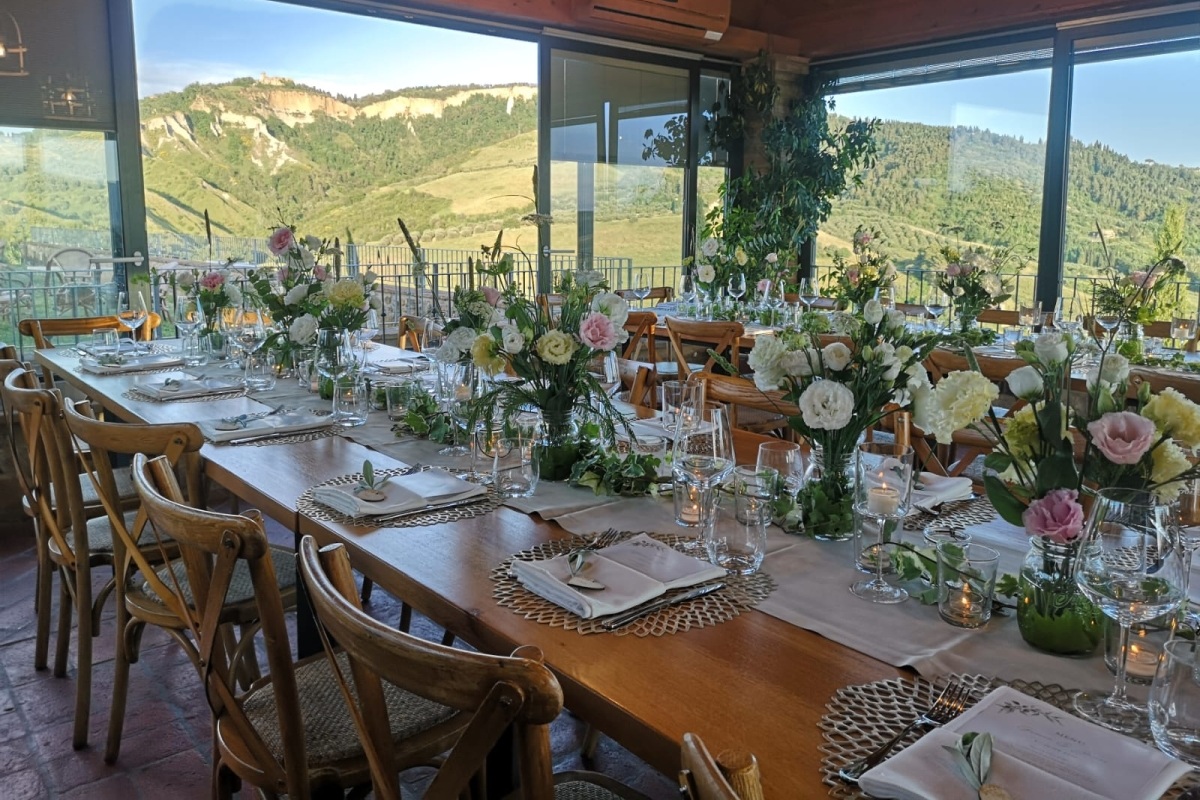
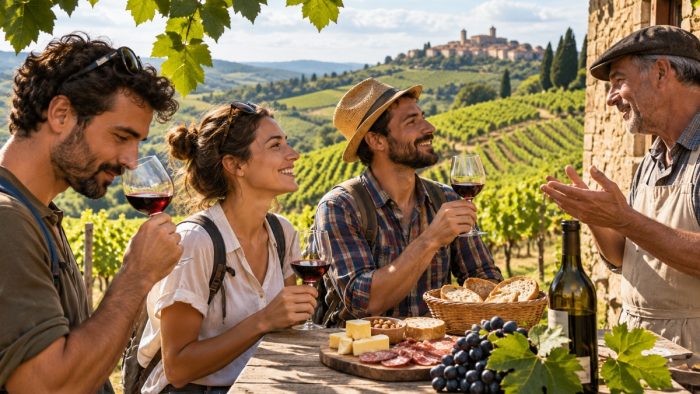
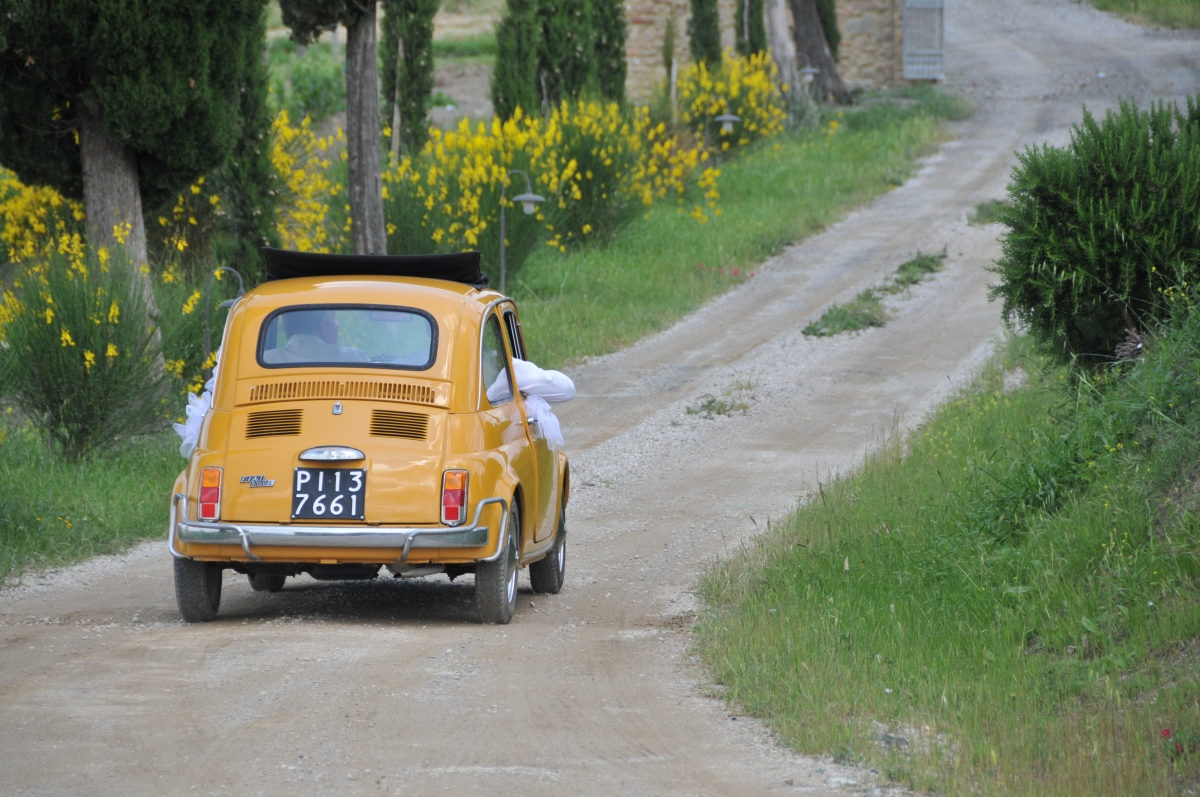
But cooking hasn’t left the scene. The estate extends over 11 hectares of vineyards and olive groves; the cottage accommodates up to 14 people in three rooms and three apartments, with a swimming pool. Increasingly, the company reports, guests book the entire structure to experience tastings, cooking classes, themed dinners and truffle hunting, and requests come from Northern Europe and America for private weddings and celebrations. Chef Alessandro Calabrese, originally from Enna, collaborates on these activities. He was executive chef of Enoteca Del Duca and trained at Arnolfo in Colle Val d’Elsa under Gaetano Trovato, from whom he learned that to create a characteristic and balanced dish you must remove ingredients rather than add them. A new collaboration is planned to welcome a maximum of 12 people. His motto: «Everything worth doing is worth doing well».