“The origins of our estate are that little yellow house. It’s the historic part, it housed the first winery,” Josef Seebacher, sales manager at Weingut Kornell, tells us. The winery has belonged to the Brigl family since 1927, but its history goes back much further. The earliest traces date back to 1190. We are in Settequerce, a hamlet of Terlano, Alto Adige. The property has inherited an ancient legacy, transforming it over nearly a century into a project increasingly focused on the great red wines of Alto Adige, a vocation carried forward even in the current era when the Bolzano province tends, following market demands, to replace red-berried grape varieties with white-berried ones.
THE MARK OF THE GRIFFIN
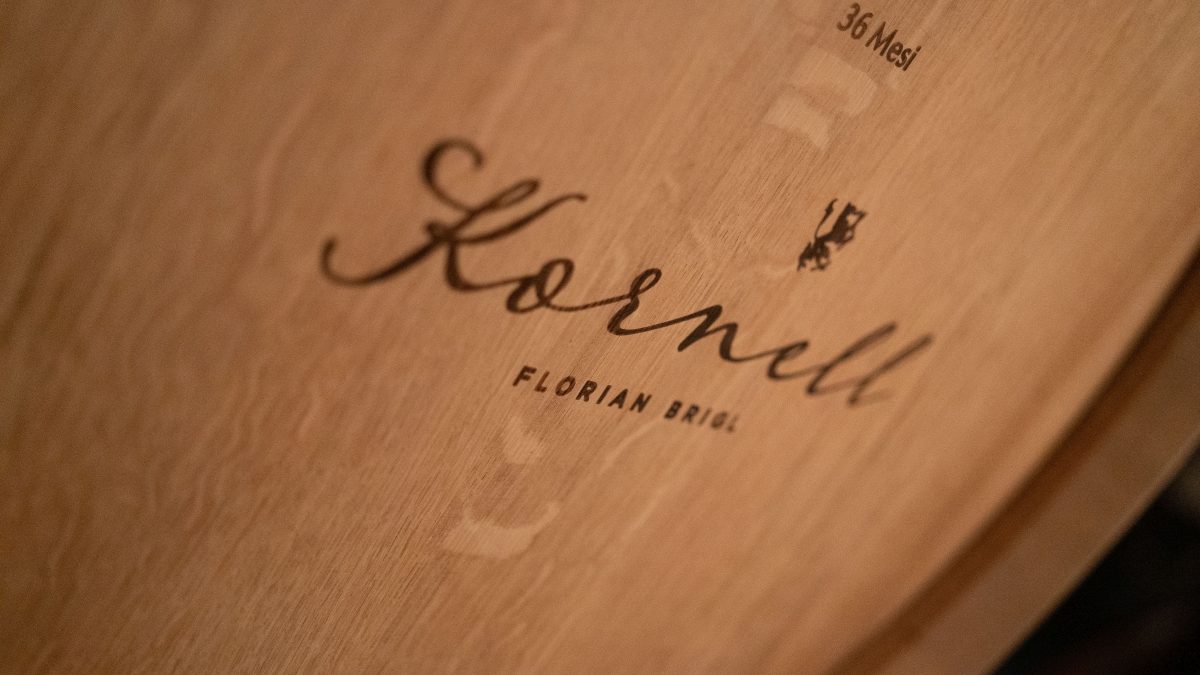
In ancient times, the complex that is now Kornell was part of Castel del Grifo or Grifone, of which some evidence remains today, including the logo on the wine labels that features the griffin. At that time the structure was linked to the life of the castle: two brothers of the Marith family managed different activities, one based in the fortress and the other engaged in agriculture and livestock raising. Later, in 1450, the main house was built, which for a long period belonged to the Muri-Gries abbey in Bolzano. It was not exactly a monastery, but rather a sort of outpost through which the abbey administered its properties outside Bolzano. A small church and some service rooms completed the complex. Historical documentation already speaks at that time of harvests and productions of both white and red wines, evidence of a consolidated wine vocation well before the modern classification of South Tyrolean wines took shape.
The Brigl family arrived at Kornell much later, in 1927. And with their arrival, they decided to add red wine production to the white wine production, gradually steering the estate toward a vocation that today seems almost natural. Kornell was already known for its grape varieties of Bordeaux origin: Merlot and Cabernet were cultivated in purity and were presented at the Bolzano exhibition as early as 1881. An early testament to what would become one of the distinctive characteristics of the winery.

WHITES IN THE SOUTH, REDS IN THE NORTH
Today the picture is even clearer. Once upon a time production was divided almost equally between whites and reds, but Tenuta Kornell is increasingly orienting itself toward the latter, based on a precise reading of the territory. The vineyards around the estate are located at approximately 350 meters of altitude, on porphyric soils of volcanic origin. It is a land that, according to the company’s vision, favors wines capable of expressing above all elegance, spicy components and smoky notes, rather than simply seeking concentration and fruit. Climate also contributes to this identity: southern exposure and high summer temperatures, sometimes exceeding 35 degrees during the hottest hours, extending into the evening and allowing red grapes to complete their ripening. The harvest can thus begin with Lagrein in mid or late September and continue until mid-October, even reaching the 15th-20th of the month with later-ripening varieties such as Cabernet. During that period the temperature range becomes particularly important. And “white” grape varieties, in this microclimate, would tend to reach overly high levels of maturity and potential alcohol. For this reason, the Brigl family invested, between 2003 and 2006, in a second production area on the other side of the valley, at approximately 600-650 meters of altitude, dedicated to whites. In a straight line, it is only three and a half kilometers from the estate, but climatically it is a different story: the annual average temperature is about five degrees lower, the sun arrives in the morning and promotes vine drying, while in the afternoon the shadow of Mendola contributes to creating decidedly cooler conditions. The result is a microclimate ideal for white grape varieties, which can be harvested two or three weeks later than the grapes from the Settequerce estate, with more balanced ripeness levels and potential alcohol around 12-12.5%. And this is how Kornell has built its contemporary identity. On one hand, the porphyry, the heat and the long exposures of Settequerce, a privileged territory for reds; on the other, the altitude and cooler temperatures, ideal for preserving acidity and finesse in whites. The range reflects this dual nature, with Pinot Bianco, Sauvignon and Gewürztraminer alongside Lagrein, Merlot and Cabernet.

STAY AMONG THE VINEYARDS
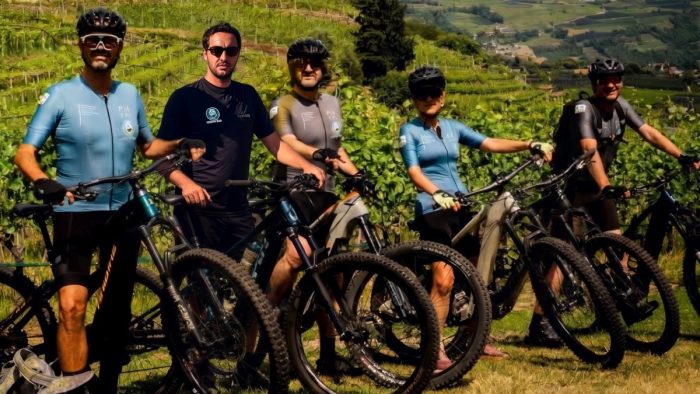
A stay at Kornell naturally includes the possibility of visiting the winery and tasting the wines produced in Settequerce and on the opposite side of the valley, but there is also the option of staying and vacationing in the vineyard. Kornell has the Schafferhaus, the oldest building, protected as a historical monument, named after the Schaffer family, the vintners who served the noble Seyffertitz-Wolkenstei family. From that building, two apartments have been created that allow guests to spend their days admiring spectacular views, becoming a base for visiting the area or an alternative to a “normal” stay in a hotel near Bolzano. For those interested in just a visit, Friday is the reference day: in the morning there is a guided tour in Italian and English, in the afternoon in German. Upon request, private visits with tastings are organized for groups of people.