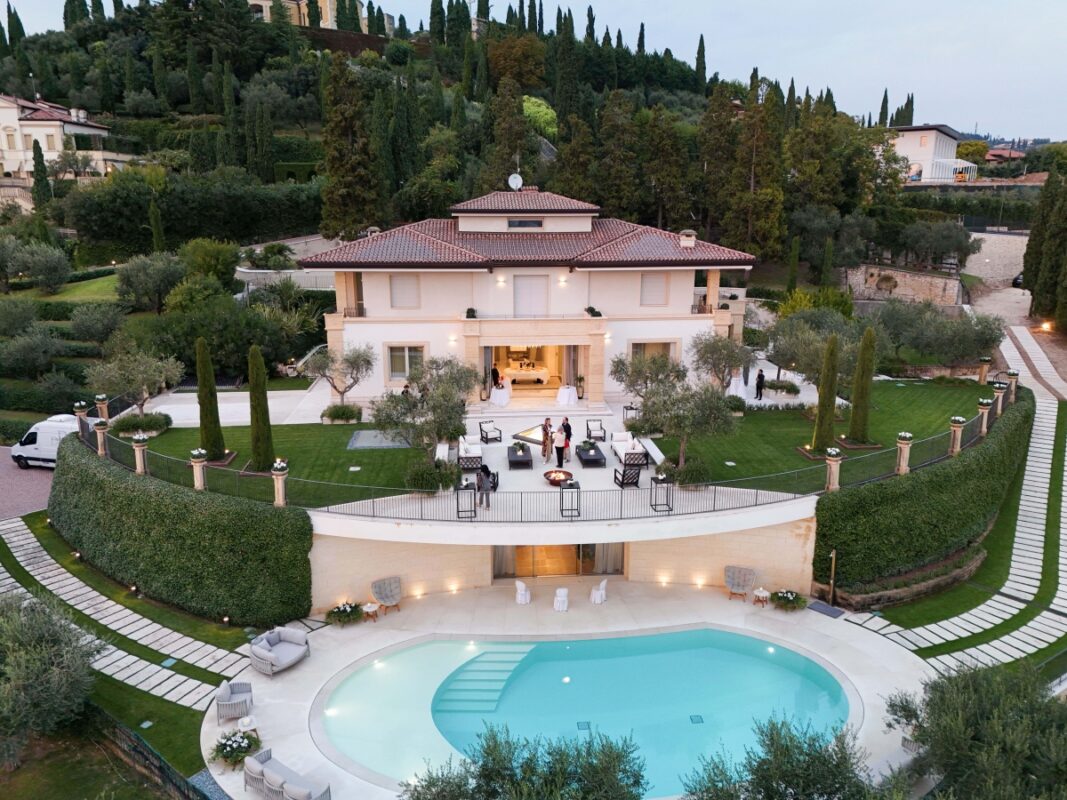
Tenuta Villa Bellini, located in San Pietro in Cariano (VR), in the heart of Valpolicella Classica, opened its doors to the press for an exclusive dinner. And we at Italiawinetour were able to hear in preview the plans underway for hospitality, already anticipated in this report.
The event, held in the evocative setting of the Torricelle, was dedicated to showcasing the estate’s organic wines, combining wine culture with haute cuisine in a pairing journey featuring the winery’s five labels.
The wine estate rises within the “brolo” (the gardens) of the villa, extending over six hectares of land, four of which are dedicated to vine cultivation. An enchanting landscape that is a true sanctuary of biodiversity, populated by centuries-old cypresses, a three-hundred-year-old oak, olive trees and enriched by a spring and a small lake that plunges into the woods. All of this rests on terroir composed of an interweaving of limestone and eocene rock foundations covered by a thin layer of soil.
INDIGENOUS VINES AND ARTISANAL PROCESSING
The estate cultivates the four main indigenous grape varieties of the area: Corvina, Corvinone, Rondinella and Molinara. The vines grow in very narrow rows, with high density and vertical espalier (bush vine) and pergola systems. This choice, while reducing yield per hectare, ensures higher grape quality and, at the same time, requires exclusively manual agricultural work. Drying occurs naturally, with only ventilation of the fruit loft, to best enhance the aromatic potential of each grape. Fermentation is spontaneous and carried out through micro-vinifications, while aging takes place in the historic cellar, in five-hundred-liter tonneaux and two-thousand-liter barrels of French oak with delicate toasting.
TRADITIONAL WINES AND THE FUTURE WINE-RELAIS
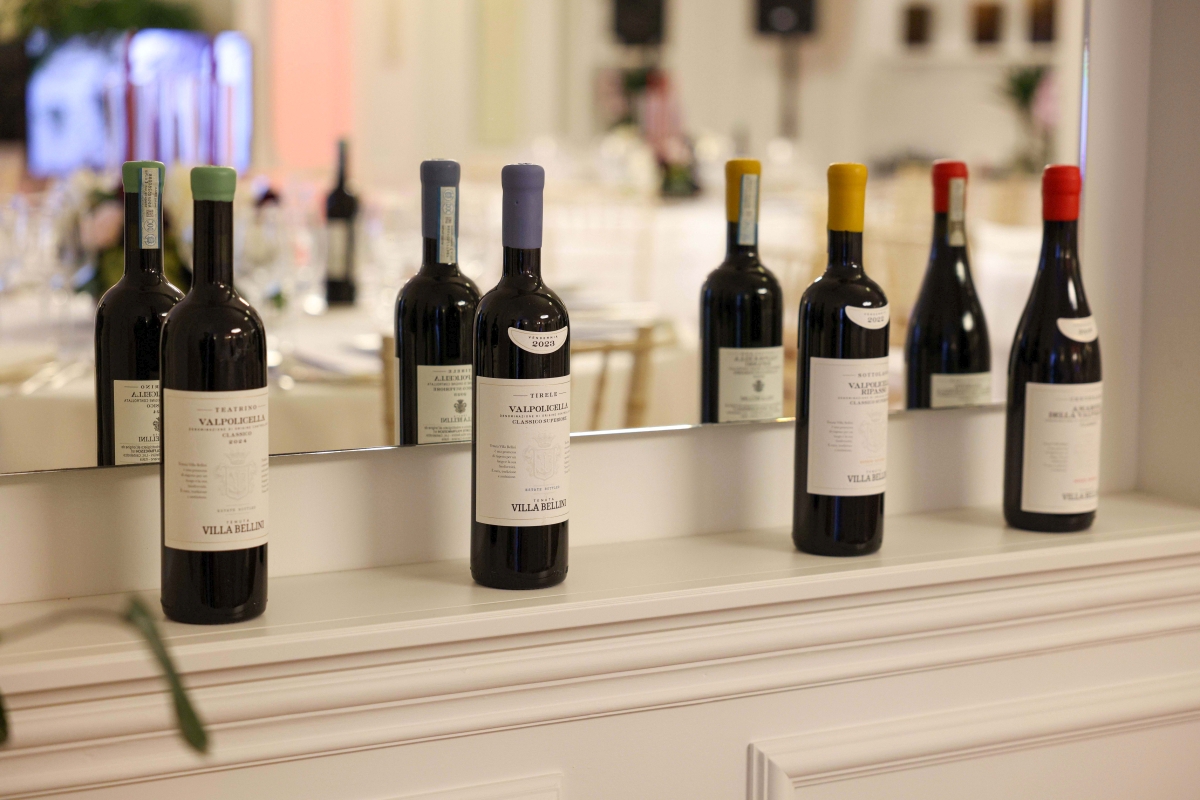
The wines of Tenuta Villa Bellini exemplify the centuries-old winemaking tradition of Valpolicella. The production consists of five references, each with a distinctive character: the Teatrino Valpolicella Classico DOC, the Tirele Valpolicella Classico Superiore DOC, the Sottolago Valpolicella Ripasso Classico Superiore DOC, the majestic Centenarie Amarone della Valpolicella Classico DOCG (currently selling the 2016 vintage), and the Millesimato Blanc de Noir, Vino Spumante di Qualità Metodo Classico Brut Nature.
In addition to winemaking activities, the estate is engaged in restoring its eighteenth-century villa, a building that in collaboration with expert restorers and the Cultural Heritage Superintendency, will become a wine-relais with eight suites, destined to become the heart of the company’s wine hospitality starting next year.
FOUR REDS AND ONE SPARKLING
The press dinner represented an opportunity to share not only the peculiarities of the wines, but also to preview the new chapter in the story of Tenuta Villa Bellini, culminating with the opening of this new accommodation facility.
With an overview of the four musketeers of Valpolicella tasted, we can say that on the nose, the organoleptic profile is dominated by typical red fruit (cherry and marasca). A core that progressively enriches with increasing concentration: from the sweet spice notes of the Ripasso to the Amarone, where natural drying unfolds complex hints of tobacco, cocoa and black pepper. On the palate, a clear progression of structure and density is observed. From the agile and slender drinking of the Classico, it rises to the robust and structured body of the Superiore and Ripasso, up to the imposing and velvety, but not excessive and invasive mass of the Amarone. Despite this growing richness, the common thread is constant sensory cleanliness and balance that never yields to excess, with a dry and slightly tannic, elegant finish. The four reds offer a true ascending journey through Valpolicella, marked by finesse and freshness
In pairing
1) The appetizer: a complex array of cicchetti with flavors ranging from marine to briny to earthy, was welcomed by the “Millesimato” Blanc de Noir 2020. 70% Corvina and 30% Corvinone, the grapes are hand-harvested between late August and early September. Slow fermentation, rests in steel until the following spring. Refermentation for 36 months and some months of rest after disgorgement and before commercialization.
This sparkling wine proved to be the perfect partner for its sharp versatility. Being a Metodo Classico Brut Nature obtained from red grapes (Blanc de Noir), its zero dosage nature and fine, persistent perlage acted like a precision cleanser, essential for tackling the creaminess of robiola in the macaron and the silkiness of whipped cod. Its mineral notes and slightly tannic structure – legacy of the red grapes of origin – guaranteed an unexpected body for a sparkling wine, successfully contrasting the fat of the speck and the bitter note of radicchio in the rolls. Fresh, full and dry, the Millesimato was able to unite the different sensory inputs, from the delicacy of the tartare to the sapidity of the cheese, leaving in the mouth a sensation of mineral and elegant cleanliness, preparatory for the subsequent reds.
2) The appetizer: Colonnata lard with croutons and veal tartare with only pepper and Castelmagno crumbs – Paired with “Teatrino” Valpolicella Classico 2024. Based on Corvina, Rondinella, Corvinone and Molinara grapes, the must ferments spontaneously in steel tanks and ages in bottle.
This pairing offered a perfect example of how finesse can overcome strength. The opening on the palate was an unexpected game of balance. The “Teatrino” Valpolicella Classico 2024 immediately demonstrated its fresh agility and winey hints of marasca, challenging the sapid richness of Colonnata Lard not with power, but with its verve. With the Veal Tartare with Castelmagno crumbs, the wine transformed from cleanser to partner. Its nuances of pepper and medicinal herbs found common ground with the earthy notes of the cheese, elevating the sweetness of the meat. A union that celebrates slenderness: its structure does not invade, but accompanies and refines.
3) The first course: tagliolini alla carbonara and truffle – Paired with “Tirele” Valpolicella Classico Superiore 2023. From Corvina, Corvinone, Rondinella and Molinara grapes, the must ferments spontaneously in steel and then in bottle for twelve months.
The pairing with Tagliolini alla Carbonara and truffle required a wine with a more robust backbone, and the “Tirele” Valpolicella Classico Superiore 2023 responded with energy. It was a true dance between the opulence of the dish and the vital acidity of the wine. The Tirele presented itself with a greater structure compared to the Classico, essential for facing the creamy and sapid embrace of egg and guanciale. This superior intensity is not accidental: it stems from a rigorous selection of indigenous grapes and targeted aging that enhances its spicy and balsamic hints. It is precisely these aromatic nuances that created the unexpected trait d’union with the penetrating perfume of the truffle. The wine’s notes of raspberry and red blueberry maintained freshness, preventing the dish from becoming heavy, while its complexity as a Superiore transformed the richness of the truffled Carbonara into an elegant complexity that cleansed the palate with each sip.
4) The second course: sliced Wagyu Beef with green pepper on crouton – Paired with “Sottolago” Valpolicella Ripasso 2022. From Corvina, Corvinone, Rondinella, Molinara and other varieties, the must ferments spontaneously in steel tanks. Subsequent infusion on Amarone pomace. Aging for about a year and a half in steel and 5 hl tonneaux and in bottle for an additional 12 months.
For the intense richness of the Wagyu Beef slice with green pepper, the palate required the density and structure offered by the “Sottolago” Valpolicella Ripasso 2022. This wine, elegant and robust, has its strength in the production method that determines its character: the Ripasso. This is the second fermentation on Amarone pomace, a process that amplifies its body and shapes its tannic structure, giving it a dry finish. It was precisely this complex architecture that tamed the opulence and marbled fat of the Wagyu meat. The fruity notes of cherry, blackberry and the sweet spices of Sottolago, supported by aging in tonneaux, magnificently balanced the buttery texture of the slice. The spicy component of the wine then created a direct aromatic bridge with the green pepper, transforming intensity into a complex harmony of persistence and depth. An encounter of great character and remarkable balance.
5) The second course: braised meat served with a spoon with vegetables and red wine – Paired with “Centenarie” Amarone della Valpolicella 2016. From Corvina, Corvinone, Rondinella and other varieties. Spontaneous fermentation in truncated-conical wooden vat of 26 hectoliters. Aging in French oak woods of various sizes for 30 months; before marketing it rests an additional year in bottle.
For the last savory pairing, the braised meat served with a spoon met the “King of Valpolicella”: the “Centenarie” Amarone 2016. This wine is not just a pairing, but an embrace of intensity. The Centenarie carries with it an imposing structural complexity, the result of the crucial process of natural drying of indigenous grapes and a long production time that amplifies every nuance. Its vast bouquet, ranging from mature dark fruits (blackberry, cherry) to tertiary hints of tobacco, cocoa, pepper and cinnamon, found common ground with the deep and enveloping richness of the braised meat and its red wine reduction. The wine’s remarkable glyceric mass enveloped the tenderness of the meat, while the tannins, smoothed by years of aging, magnificently supported the density of the sauce. It was a fusion of persistence, where the power of Amarone aligned with the consistency and intensity of the braised meat, leaving a warm, majestic finish.