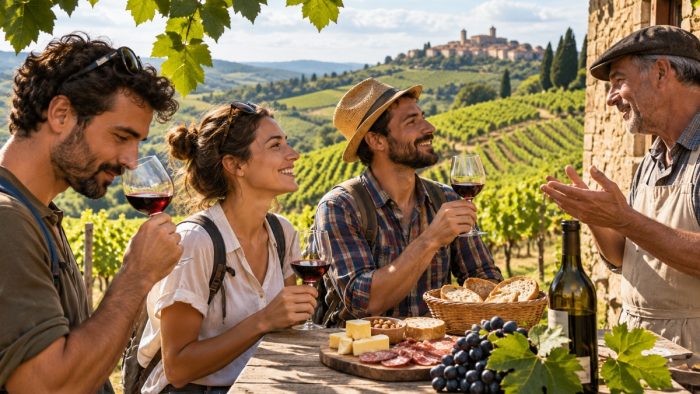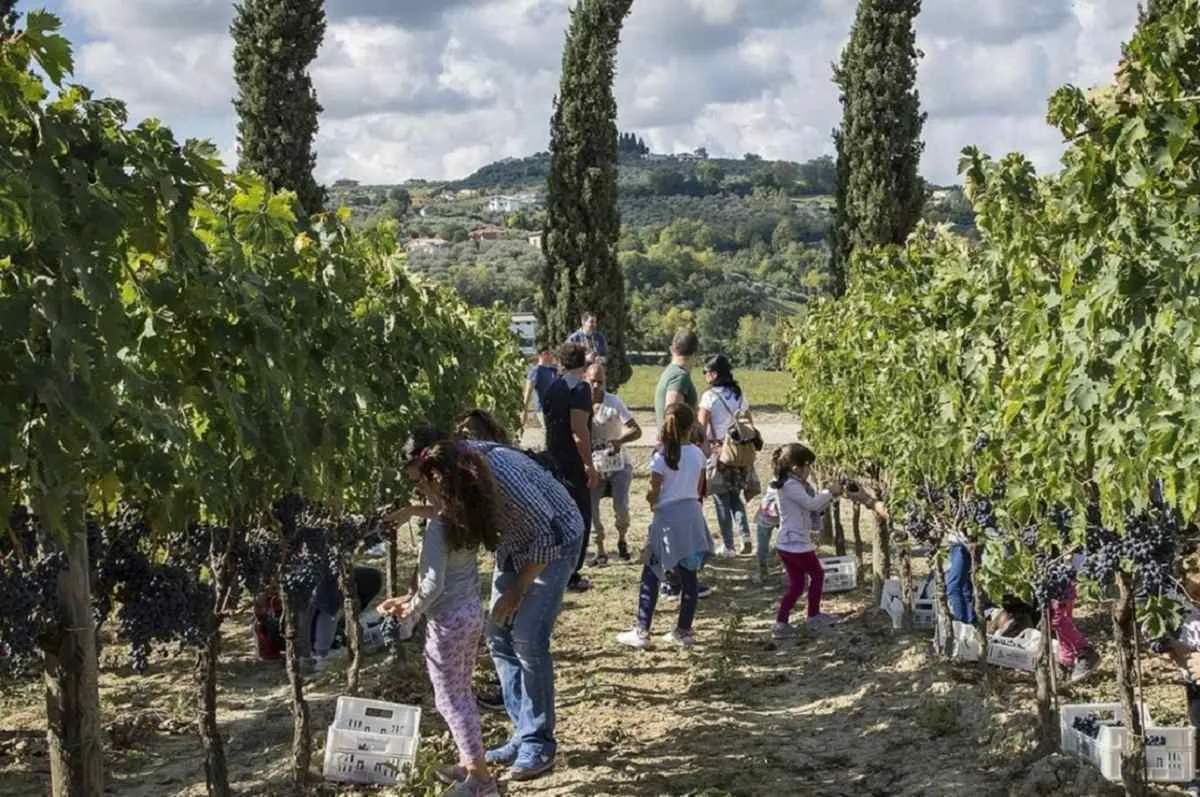
Wine tourism in Italy is thriving and for the country’s wineries, a future of new challenges and opportunities is opening up. This is revealed by a survey conducted by Movimento Turismo del Vino and CESEO observatory (Centro Studi Enoturismo e Oleoturismo dell’Università LUMSA) on a representative sample of 237 MTV member wineries for 2024.
Thanks to the implementation of wine tourism services, 53% of the sample recorded an increase in revenue while for almost 1 company in 4 (24%), growth was even double-digit.
Despite the positive trend, the sector complains of a constant increase in costs, reported by 81% of wineries; increases that erode profit margins and which in many cases are particularly significant (29% record growth between 5% and 10%, 16% report an increase between 10% and 25%, and a significant 8% declare an increase above 25%). A particularly critical scenario especially for small-sized companies that represent a large part of the sample (64% micro-enterprises, 31% small enterprises). It should also be remembered that only 9% of wineries exceed 2 million euros in annual revenue.
“When we talk about wine tourism we refer to a constantly growing sector, with annual growth of 13% on a global scale – emphasizes CESEO president Dario Stefano – and which finds in Italy the possibility of its maximum expression globally. However, this leading role requires qualified analytical support, a research and investigation point as CESEO intends to be, that traces guidelines capable of being a compass toward sustainable and possibly homogeneous growth of territories and their actors; a stimulus for government policies and, at the same time, a driver to prepare training programs capable of providing figures and skills that are more necessary than ever for the sector“.
“The study represents an in-depth snapshot of the activity of Movimento wineries, increasingly diversified, dynamic realities with a sustainability-oriented outlook – explains Violante Gardini Cinelli Colombini, president of Movimento Turismo del Vino – We involved our companies from the start because we strongly believe in the Study Center’s potential in conducting high scientific rigor research oriented toward enhancing the sector’s peculiarities and, at the same time, systematic analysis of criticalities and opportunities. The survey will allow us to develop training courses for tourist wineries, support regional presidents with updated and reliable sector data, encourage MTV members to improve their offering by consolidating the leading role in Italian wine tourism“.

INITIATIVES AND EXCELLENT PRODUCT QUALITY, BUT WINE HOSPITALITY NEEDS IMPROVEMENT
Another element of the survey concerned the role of professionalization and skills within companies: currently only 38% of tourist wineries have staff with specific wine hospitality competencies. In others, it’s often the owner who receives visitors (63%), if not the employees themselves. But vineyard and winery hospitality is a much more complex format and the path to equipping wineries with specific staff is still in its early stages.
Hospitality is indeed the central theme for an association like Movimento Turismo del Vino which, for over thirty years, has worked to make the winery experience more accessible and inclusive. A direction demonstrated by the improvement of hospitality standards, both at a structural level, regarding the presence of parking, equipped tasting rooms, camper rest areas and accessible paths for people with mobility difficulties, and at the level of complementary activities offered, particularly those carried out outdoors. The survey reveals, in fact, that landscape is one of the main attractions both for proposed initiatives (33% of wineries organize vineyard picnics, 30% vineyard walks) and at an environmental level (43% of companies are organic, 38% respect sustainable agriculture standards). Additionally, 26% of interviewed wineries provide electric car charging stations.
The research also shows that MTV wineries’ offerings are characterized by a variety of experiences, not only during Cantine Aperte: 65% of companies focus on a limited number (up to four), while the remaining 35% diversify more, offering from five to eighteen different activities, from more traditional ones to more exclusive initiatives. 87% of wineries also offer typical regional products during tastings, 25% organize dinners with the producer and 20% cooking classes.
Attention also for families, in fact 38% of the sample organizes educational experiences dedicated to children, also with equipped play areas and organization of visits to educational farms.
Wine experiences start from 15 euros to peaks of 150, with an average of 25 euros. An offer now extended to weekends by an increasing number of wineries. 85% of companies are then visitable year-round and 68% accept visitors even without appointment. An offer extended in time, articulated and with ad hoc proposals according to seasonality.

INCREASINGLY “SOCIAL” WINERIES BUT THE FUTURE IS AI
Regarding digitalization, concerning communication channels the website proves to be an indispensable tool, although it’s not yet employed optimally in terms of visibility and customer loyalty (42% of wineries record less than 1000 monthly visits and 15% don’t regularly monitor access numbers). Similar situation for mailing lists, to which 42% of wineries send monthly communications while 33% at least three times a year. The study clearly shows that the key element of promotion strategy is social media: Facebook remains the most widespread social platform (97%) together with Instagram (96%). LinkedIn plays a more marginal role (37%), probably because it’s perceived as a more b2b-oriented channel, and TikTok (only 7% currently). The data highlight a notable online presence by wineries, however, in most cases, this doesn’t correspond to a concrete increase in visitors. The step to increase contacts and transform them into direct sales involves creating wine clubs, using CRM (Customer Relationship Management, present in only 21% of companies) and, no less important, correct and conscious use of artificial intelligence. Currently, only 20% of companies declare using AI tools; of these over 70% employ them in digital communication, 63% in marketing activities, 35% in booking management while only 8% in production processes. The still limited adoption by producers could be attributed to the perceived high implementation costs but also to the predominantly traditional nature of many wineries. Obstacles that represent one of the main challenges for MTV companies’ growth and consequent sector development.