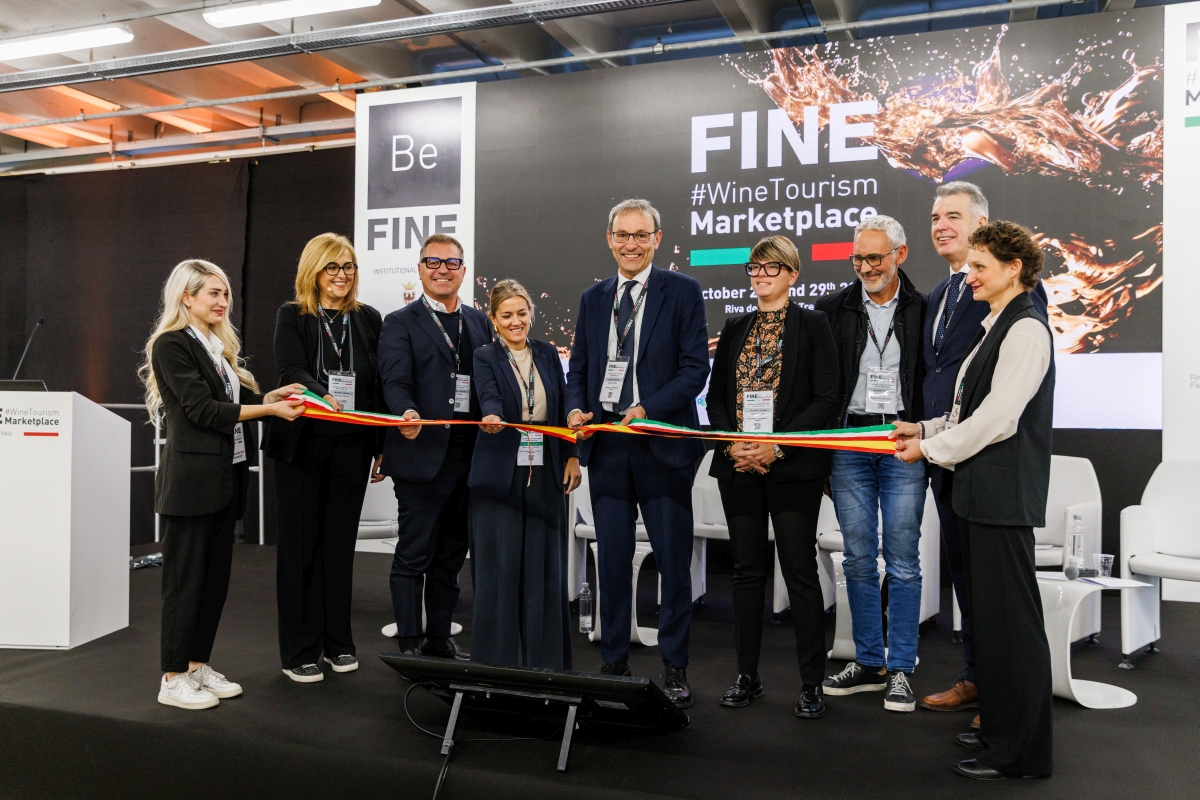
A good start, as they rarely say in the director’s booth. And on the set of Riva del Garda, where the “premiere” of Fine Italy took place on October 28-29, the long-awaited phrase was proclaimed by the actors, or rather, in this case, by the wineries investing in wine tourism.
A good start because the wineries found exactly what drove them to join this absolute novelty, consisting of a moment that was not so much a trade fair, like those that generally promise top meetings and then turn into open doors for enthusiasts to taste free glasses, but a real dialogue with buyers. Who in this case are called tour operators.
Riva del Garda Fierecongressi did its job well, providing exhibition spaces and offering a good level of service to exhibitors, buyers and press. Feria de Valladolid, partner for the occasion as the leading European trade fair organization in this field (with Fine #WineTourism Marketplace, next edition March 3-4, 2026), did its part well, bringing the leading groups in organizing trips that include winery visits. In this way, wine companies were able to reach an audience that is rarely present at wine fairs and more likely attends tourism ones, where however the focus of the visit is represented by hotels, transport companies, services. Ultimately, Italy was missing such a specific and well-structured moment.
On our part, as Thenews24, with our publications Italianwinetour and Vinonews24 we covered the two days of the fair comprehensively, collecting video interviews – all the work is already available on Instagram, Facebook and LinkedIn social profiles – and discussing with wineries to imagine an increasingly important future for hospitality in wine companies. The numbers presented in Riva del Garda, moreover, highlighted all the potential of wine tourism and the ongoing evolution in demand but, based on the Report presented by Roberta Garibaldi and Srm (Intesa Sanpaolo), also the limits related to the evolution of supply channels, communication and access to information using AI, an increasingly strategic topic because today over 30% of tourists create their own travel itinerary using ChatGpt, Copilot, Gemini and other software available online. If you’re not there, you’re not visible and you don’t attract tourists.
In short, it’s clear that wine tourism is increasingly a strategic business and that territories, even more than companies, must start getting serious. And so we ask ourselves: where were regions like Lombardia or Emilia Romagna during these two days, for which Riva del Garda is not that far away – from Valténesi, for example, you can even get there by boat if you want! – instead of attending Fine Italy? Why did no Lombard, Emilian-Romagnan, but also Abruzzese, Pugliese, Ligurian winery decide to invest a more than sustainable amount to intercept this business potential? Why was there only one winery representing Piemonte, which was moreover very satisfied? Why wasn’t there more massive participation from Veneto, from Toscana?
A matter of choices, agreed, and also of available funds, but it seems we can say that the investment made by regions present in a much more substantial way at Fine Italy such as Campania, Calabria, Sicilia (with Assovini), Friuli Venezia Giulia (with Io Sono Friuli Venezia Giulia) and naturally by the autonomous province of Trento which was playing at home (with Trentino Marketing) was rewarding and the wineries themselves were able to see this. But the benefit of this investment is not limited to the wineries present: it will fall on all their territories, because the economic return of tourism brought by tour operators goes well beyond the sale of one or more bottles of wine. And until this aspect is understood, wine tourism will always remain a beautiful prospect and never a system project.