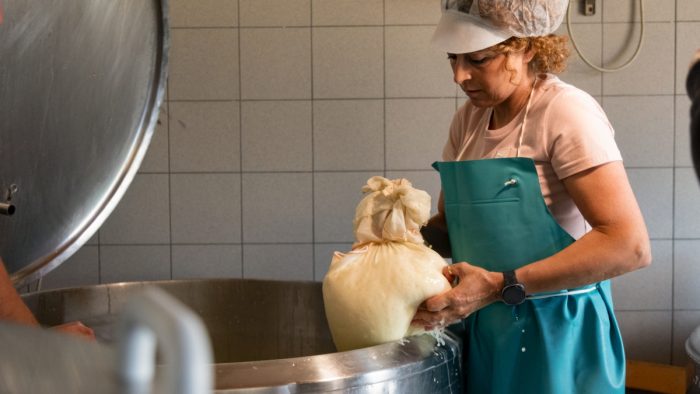
We meet Eduard Bernhart, director of the Consorzio Vini Alto Adige, to understand the connections between the wine world, as he has been leading the Alto Adige consortium for four years, and the experiential context that makes the wine world interact with other sectors related to food and tourism through events often aimed at enthusiasts as well as operators and press.
WINE AS THE PROTAGONIST IN HOTELS
Where to organize an experience? For example, at Vinum Hotels the vacation becomes a sensory experience where wine is the protagonist, where you can taste the finest Alto Adige and international labels, as well as participate in numerous cultural and wellness activities. In this way, it’s possible to live authentic experiences, like the people and wines of this ancient wine region.
“Our wine – Eduard begins – inimitably embodies the rich facets of our mountain territory, combining Alpine and Mediterranean influences. This tradition has been passed down through generations and gives strong impulse to innovation, perfection and intuition, quality and creativity, ease and reliability”.

THE SEVEN ZONES
Without doubt, to experience close contact with all facets of the wine world, it’s interesting to explore the 29 Vinum Hotels, all family-run, where all properties are located in the region’s wine zones and are managed by great wine enthusiasts who have a close relationship with their territory. The hoteliers take guests by the hand and lead them to discover the vineyards and cellars from which the finest wines originate. Located in as many as seven different zones, you can choose from: the wine zone of Merano e dintorni where Schiava Colli di Merano has always been present, alongside delicate Pinot nero, the great elegance of Gewürztraminer and Pinot bianco. Then follow the consistently higher daytime temperatures of Bassa Atesina that give a Mediterranean character to the landscape and wines. From international-level Merlot and Cabernet grapes, to Italy’s most famous Pinot nero, to Sauvignon, Pinot bianco and Gewürztraminer. Then, almost entirely displaced from the valley floor due to apple orchard expansion, viticulture has retreated to the gentle slopes of Val d’Adige, giving life to the wine zone of the same name. The quality of the wines is extraordinary, from Sauvignon to Chardonnay and Pinot Bianco, to fruity reds, Lagrein and Merlot. The Oltradige wine zone includes Appiano and Caldaro. The extraordinary quantity from velvety Schiava to Pinot varieties, passing through Merlot, Cabernet Franc, Cabernet Sauvignon and Chardonnay. The Alto Adige valley famous for wind gives life to the Val Venosta wine zone where you find Gewürztraminer and Pinot Bianco with fresh mountain acidity, Pinot nero and a small production of Zweigelt, a rare native variety shared with Austria. In summer, the Bolzano basin often records Italy’s highest maximum temperatures. Here develops the Bolzano e dintorni wine zone that produces an extraordinary Lagrein, today one of the flagships of Alto Adige reds, and a more full-bodied version of Alto Adige Schiava, particularly appreciated by industry critics. The stronghold of whites is the Valle Isarco wine zone where warm summer days and cool autumn nights give these grapes extraordinary compactness and aroma concentration.
DIFFERENT COMBINATIONS
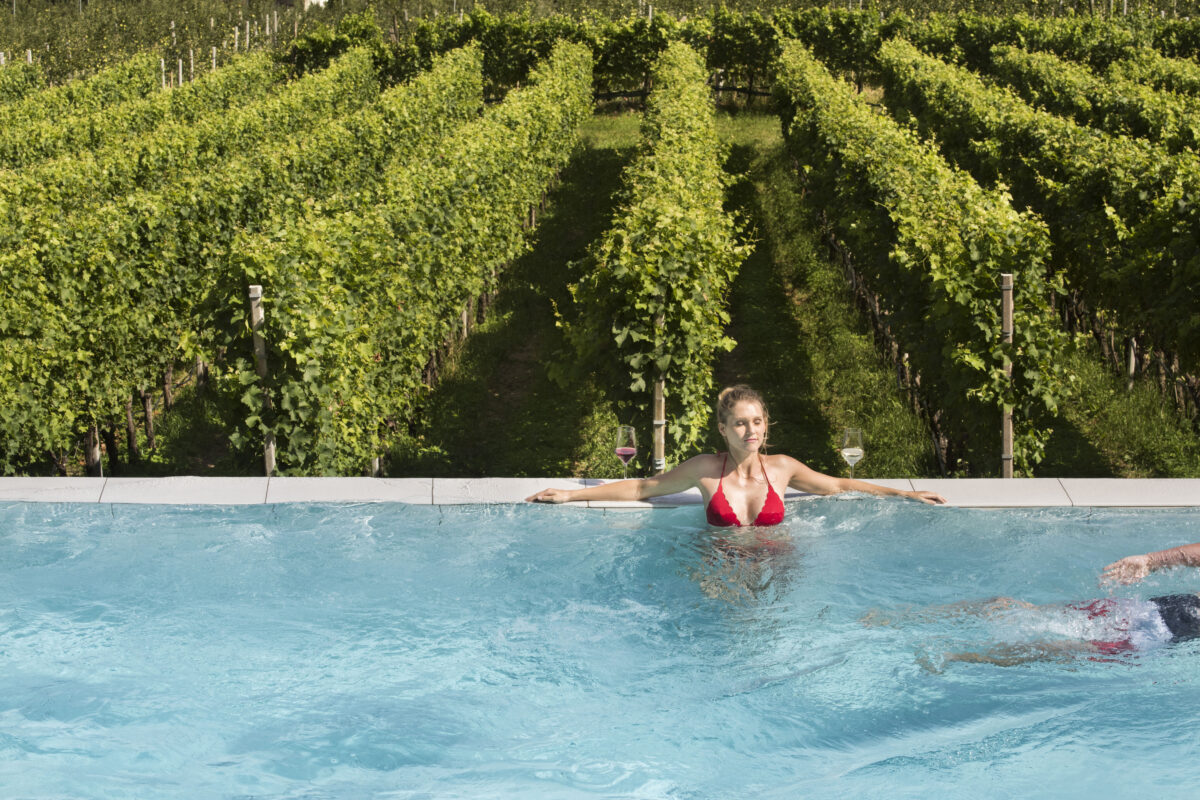
Each Vinum Hotel, while sharing the group’s philosophy, has its peculiarities. For this reason, themed pairings have been created that could facilitate choosing the right property for your vacation. These range from Wine & tradition where hotels are true guardians of history and vacation becomes an opportunity to discover Alto Adige traditions, customs and ways of life, to Wine & design for an aesthetically beautiful vacation, in properties with precise lines and futuristic forms, with innovative furnishings and classy accessories. From Wine & wellness where you find saunas, massages and beauty centers for total well-being, to Wine & activities for practicing sports and discovering Alto Adige’s mountains on foot and by bicycle. Finally Wine & romance includes hotels for lovers, seeking a love nest away from everyday frenzy.
NUMBERS AND HISTORY OF ALTO ADIGE
Alto Adige is located between Austria and Switzerland, in Italian territory, between the boldest peaks and Mediterranean landscape, between Italian culture and the German-speaking world, between healthy cosmopolitan curiosity and love for one’s own traditions. In terms of extension, Alto Adige is one of Italy’s smallest wine territories, but thanks to its geographical position it’s also one of the most varied. Viticulture, in fact, extends from the feet of the highest alpine massifs in the North, to vineyards of a decidedly Mediterranean landscape in the South. 5,000 winegrowers share a vineyard surface of just over 5,600 hectares, distributed in the most disparate climatic zones, on different soils and at altitudes varying between 200 and more than 1,000 meters. An extremely differentiated terroir ensures that many grape varieties find ideal growing conditions. In vineyard and cellar, Alto Adige winemakers can count on experience matured and passed down from generation to generation, combining it with growing attention to natural and sustainable viticulture, and constant desire for renewal. Independent winemakers, cooperatives and estates have achieved great results for decades also thanks to the contribution, always protected and safeguarded, that comes from small family-run structures. Together, but leaving each their own imprint, they pursue the declared objective of protecting nature, safeguarding traditions, protecting the territory understood as an identity factor and common heritage and look to the future with environmental sustainability for future generations.
Already in 1893, in Andriano, Terlano and Egna the first cooperative cellars were born, which from that moment began to vinify in centralized plants the grapes delivered by all associated winegrowers, distributing the wines obtained under their own name. Until the outbreak of World War I, 13 more would be added.
In 1931, the Royal decree on typical wines established a certain geographical delimitation of origin zones, and that provision, which first introduced quality protections and guarantees, was the forerunner of the 1963 Law that introduced DOC regulation, establishing for the first time in Italy a “controlled designation of origin” to protect consumers. Today, 98.8% of all Alto Adige’s vineyard surface is subject to DOC regulations, and it’s the highest percentage among all Italian regions. Since 1980, Alto Adige wines have embarked on a phase of profound relaunch that has never stopped until today, and the credit goes to a series of winemakers animated by great courage and foresight, who consistently chose the strategy of qualitative innovation: vinification of grapes by vineyard, drastic reduction of yields and adoption of avant-garde techniques and methodologies have produced a surprising quality leap.
Since 2007, all subjects revolving around the wine world in Alto Adige have organized themselves in the Consorzio Vini Alto Adige. From that moment, starting from the Italian market, the Consortium has opened the way to outlets in many new international markets. At the same time, this province has established itself as Italy’s most appreciated production zone for white wines, as demonstrated by the fact that for years it has boasted the highest number of awards and recognitions in relation to cultivated surface.
“Ambition, perseverance and precision are in our genes and we are very demanding, especially with ourselves. We climb one peak and already think about the next one, always projecting ourselves one step ahead. From here springs our tendency toward quality, which is expressed in our wines and in a symphony of flavors that satisfies all the senses”. Bernhart emphasizes.

THE TASTING: THREE EXPRESSIONS OF SCHIAVA
We conclude this in-depth look with 3 wines from Schiava grapes obtained particularly from both century-old vines and those dating back 70 years. This native grape variety boasts documented traces dating back to the late Middle Ages, and since the sixteenth century has always been the reference variety in Alto Adige viticulture. From Schiava mostly light wines are obtained, with low tannin and alcohol content, with different individualities and typicalities. Santa Maddalena, for example, stands out for its fullness qualities, while Lago di Caldaro and Colli di Merano are softer and more spiced on the palate. It’s drunk fresh in summer and more tempered in winter with velvety tannins, soft acidity with fresh notes of unripe raspberry, pressed grape, cranberry, wild strawberry. It’s a grape variety that ages very well, even if it doesn’t have great acidity or important tannins.
“It’s our – Eduard concludes – everyday wine, perfect with traditional dishes, but absolutely fantastic in expressions from past years obtained mostly from old vines”.
GIRLAN – Gschleier Vigne Vecchie Schiava Alto Adige DOC 2020
Gschleier is certainly one of the most renowned Alto Adige viticulture zones. The vines boast an age between 80 and 110 years, a uniqueness in Alto Adige viticulture. The vines are located at a height of 450 meters altitude, on terrain of calcareous, clayey and gravelly conformation. The position and exposure of the slope guarantee optimal sun exposure that creates a wine with great aging potential. Harvest occurs manually in small containers for transport to the cellar. After destemming the must is brought by gravity into stainless steel tanks for fermentation. After malolactic fermentation it matures for 9 months in large oak barrels and 6 months in bottle. Schiava, called Vernatsch in local lexicon, is elegant, full-bodied, with fruity tannins accompanied by decisive sapidity. It remains a wine with above-average aging potential.
MANINCOR –Lago di Caldaro Classico Der Keil Alto Adige DOC 2021
This Schiava comes from a vineyard at 250 meters, with southern exposure and lake view, among Alto Adige’s warmest vineyards. The century-old vines are rooted in calcareous, clayey-sandy soil. The training system is the traditional pergola. For the 2021 vintage the clusters were harvested in mid-September. For vinification, fermentation occurred in wooden tanks, spontaneously thanks to indigenous yeasts. During the five months of maturation in oak barrels and in contact with yeasts, both aroma and taste were refined. This wine has a brilliant ruby red color in the glass. On the nose it has delicate notes of cherries and toasted almonds, then has intensity on tasting, smoothness, silky tannins, freshness to balance the sip with pleasant persistence in the mouth.
ROTTENSTEINER – Santa Maddalena Classico Vigna Premstallerhof Alto Adige DOC 2021
The wine produced with Schiava (93%) and Lagrein (7%) comes from a pergola vineyard from the ’80s, on porphyric sandy soil, with southeastern exposure, with part of the vines also 70 years old and the remaining part averaging 30 to 35 years. The Premstallerhof farm and related vineyard are located in Santa Maddalena at an altitude of 400 to 500 meters and is certainly not only one of the largest farms in the area, but also one of the best from a quality standpoint. Since 1962 the Premstaller farm has been owned by the Vogel family, Swiss wine importers who with this farm realized their life’s dream. The farm is worked directly by Mrs. Getrud Vogel in a biodynamic way. For vinification, after fermentation in steel tank the wine matures partly in oak barrels. It begins with an intense ruby red, a fine aroma of violet and cherry, a full flavor with very soft tannins, all with beautiful persistence, remaining a wine that doesn’t only appeal to Schiava lovers.
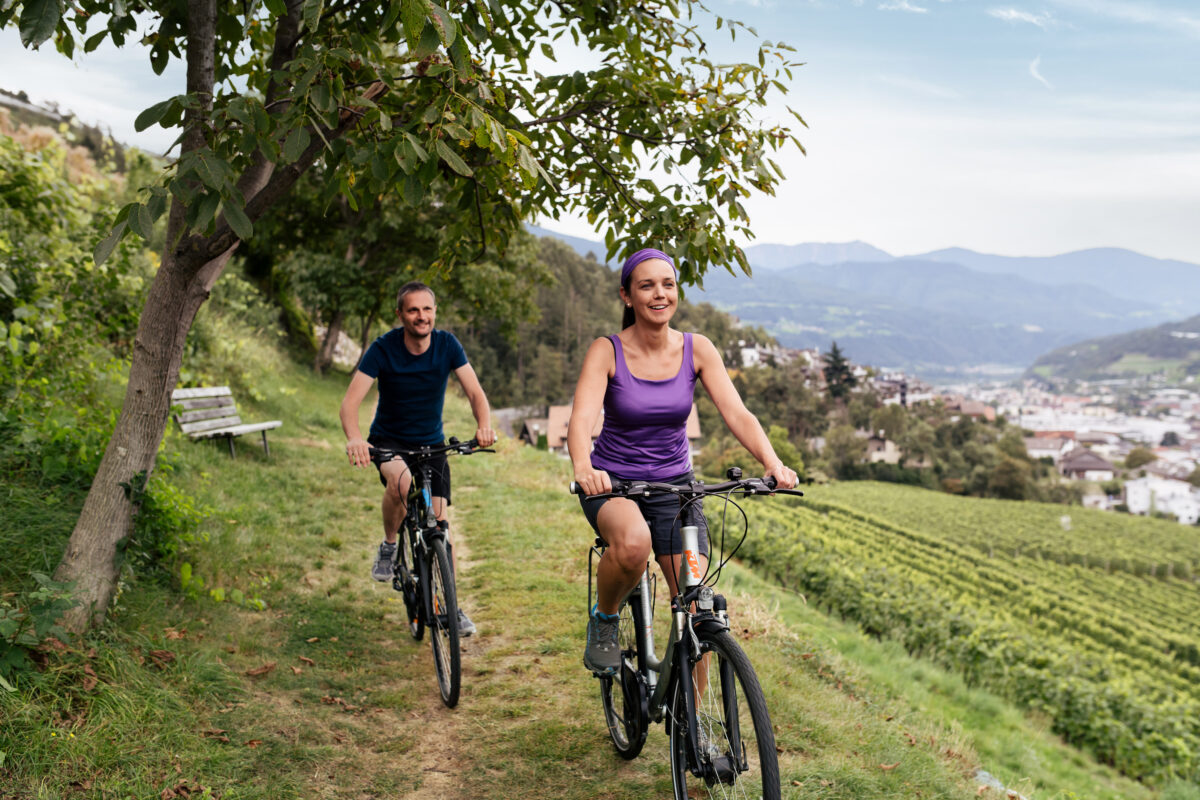
Photo @ Alex Filz, Florian Andergassen, Consorzio Vini Alto Adige, Girlan, Manincor, Rottensteiner