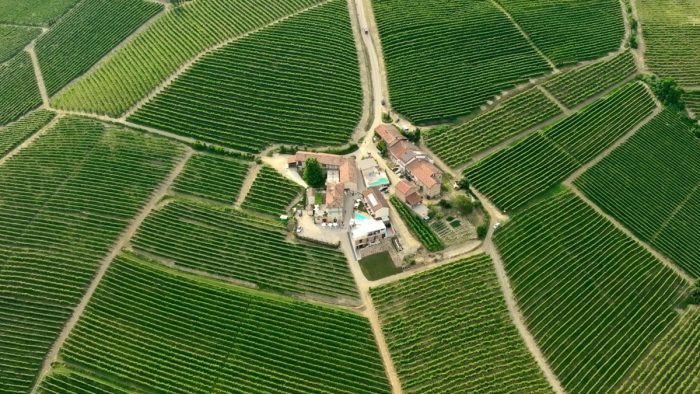
We decided to discover the beauty of Alto Monferrato, a place to which Italianwinetour has already dedicated much attention, and we did it by bicycle, calmly, without overdoing the kilometers and deepening our knowledge of wines, people, landscape and culture of the territory. The journey is feasible for anyone, without great effort, without having to face overly challenging climbs. Just a little attention and prudence along the road. Here’s the first of four stages of a loop route, which can continue or, if desired, can also be closed in a single day.

THE STORY BEGINS AT BERSANO
For the starting point of the itinerary there’s no doubt: Bersano Vini is not only part of the history of the territory of Nizza Monferrato, but also the most strategic solution logistically because it directly faces the town’s railway station. As proof of this, the 1898 steam locomotive preserved (a gift from the Italian State) by the company inside its Museum of Country Life, one of the three main attractions to admire and visit together with the Print Museum and, naturally, the winery founded in 1907 by Arturo Bersano. “Bersano ages wines to rejuvenate men,” reads the inscription on the first barrel, “number one.” The wine tourism experience could last six hours, but is concentrated by the incoming staff into a couple of hours between visits to the museums, cellar and tasting. Today the company, owned by the Piemontese Massimelli family, has 230 hectares of vineyards throughout the territory of Basso Piemonte, from Langhe to Acqui, but Monferrato is the beating heart of its activity. The Nizza cellar develops vertically, a choice made in the past to defend against floods from the Belbo stream, and houses large barrels active since the 1960s. “Bersano is territory, men, tradition” states Federica Massimelli, CEO of the company. Her property includes ten farmhouses, with various projects under study for hospitality.

TASTING IN THE KITCHEN AT CASCINA LANA
You can mount your bike here, at Bersano, at the end of the tasting. Being in front of the railway station, a good (and sustainable) solution to reach Nizza Monferrato is precisely the train from Asti. Alternatively, you can leave your car in the station parking lot, which is also free, renting traditional bicycles (the experts would say “muscle-powered”) or e-bikes through the Bikesquare circuit, which on request delivers them directly to the winery. From here you start along the Turchino provincial road, a somewhat busy but historically rich and fascinating road, and after just over 3 km uphill you reach Cascina Lana, where we find Diego Marcellino welcoming us, who with his wife Giorgia Turco (oenologist) manages the company owned by Nino Baldizzone, who is, by Diego’s definition, “mainly assigned to the vineyard.” It’s a relatively small reality (24 hectares) with reduced bottle production, just 75,000, because most of the wine continues to be sold as bulk, and is stormed by “demijohn buyers.” Nevertheless, they make 21 different labels, from Brachetto D’Acqui to Freisa d’Asti, but Barbera is the core business with 70% of production in all its variations. Wine tourism is growing strongly, today we’re talking about 1,500 visits per year which might seem like little, but Diego manages them alone, also because only five people work at the company! The packages include five glasses and two dishes (20 euros per person) or six glasses and three dishes (30 per person) and take place in a room that is basically the home kitchen, and this makes the experience at Cascina Lana something truly unique and familiar. And then there are the “customizations” of the tasting experience, from the external courtyard to the vineyard row up to the ciabot which is granted to those who ask for it. To discover the wines of Cascina Lana you need to go to Monferrato, because they don’t participate in any fair except the Piacenza one for Fivi producers. “Everything we save, we invest here” Diego tells us.

ART PARK AND CELLAR, WELCOME TO MICHELE CHIARLO
Monferrato offers truly evocative landscape views, what’s missing (for now) are bike paths. So, to reach Calamandrana avoiding the busiest route, you climb towards Castel Boglione, then detour to provincial road 118 where the presence of cars becomes almost absent. Here, with necessary caution, we can also use our smartphone to shoot some short videos while riding. A long and enjoyable descent takes us to the Calamandrana junction where we turn left and arrive at our third winery. The name is important: Michele Chiarlo was a visionary, regarding wines and the very concept of hospitality in Monferrato. Legend has it that he was the one who placed the first benches in the area, to welcome visitors to the territory and wineries. Beyond the legend, reality is before everyone’s eyes, like the art park that Chiarlo created at La Court, the Nizza docg estate. And like the development his company has had, born in 1956 right in Calamandrana, with the transformation of the area’s most typical grapes (Moscato and Barbera) and then grown through acquisitions reaching 110 hectares of vineyards between Langhe, Monferrato and Gavi. The Calamandrana cellar is a sort of museum and hosts exhibitions by contemporary artists, but then visitors’ attention goes to the first Barolo vintage (1958), to the breadth of the company portfolio, (Barbaresco, Nizza, Gavi, naturally the Moscato d’Asti which represents with Barbera most of the company production and has an election market in the USA), to the splendid labels designed by Giancarlo Ferraris, to the awards won in history. Cellar visits can be booked online and the cost varies from 30 to 50 euros based on the formula. The visit to Art Park La Court, instead, is free.
ROUTE ANALYSIS
Here ends our first day of visiting the territory and we decide to stay overnight in the area, at the Le Due Cascine agriturismo in San Marzano Oliveto, for a total of 18 km covered with 258 meters of ascent and 220 of descent. Come on, we can say that on our Monferrato debut we worked harder at the table than in the bike saddle… If instead you want to return to Nizza station, to close the circle, it’s exactly 24 km. It’s really child’s play, but tomorrow we’re back to pedaling.