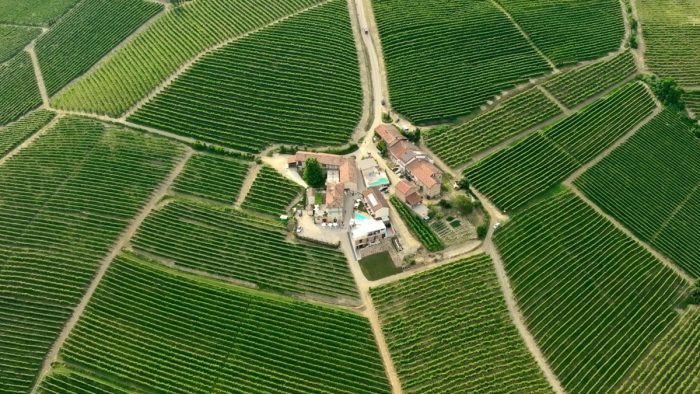
The Germans kept us company until late at night. A group of thirty motorcyclists on a free ride, who came to Monferrato to drink beer and that alone could be enough to categorize them, brightened our night giggling like madmen both after dinner and before breakfast. So we leave Le Due Cascine, with our eyes still a bit heavy from sleep and promising ourselves to return in the height of summer, when the pool will be operational and when our German friends will be at the seaside or Lake Garda, but not among the UNESCO heritage hills and not at Le Due Cascine where, moreover, the restaurant prices are modest and they prepare an excellent fassona tartare.

L’ARMANGIA OR THE REDEMPTION OF CANELLI
The first stop of the second day is L’Armangia in Canelli. To get there by bike there are two possibilities. The shorter one is initially downhill and then all flat, and is naturally the fastest but also the most trafficked and you even cross an industrial area. The advice therefore is to climb up the hill along strada Marziano, with about seventy meters of ascent and then down in descent, enjoying the panorama and with little chance of encountering a car. The incredible October weather gives us a barely cool morning and the gentle sun is already breaking through the mists, making the atmosphere muffled and magical. L’Armangia is the realm of Ignazio Giovine with his wife Giuliana. They are Fivi producers, and it’s the only credential that seems to interest them because here more than “labels” they care about substance. The Giovine family has been making wines since the mid-1800s, the father was allergic to sulfites and basically spent his whole life vinifying with the lowest possible level of sulfites to be able to drink in peace and in full health. Ignazio started from scratch and called his company with a term, armangia, which in Piemontese means revenge. Why? Once Canelli was the city hostage to the big Moscato industry, which then meant low price and quality. The challenge was therefore to enhance the territory and having succeeded, for Ignazio, was a revenge. Among the visit proposals with tasting appears L’Armangia Easy, and it’s unbelievable… They offer three glasses for free and the question arises spontaneously: why do you do it? “Because nobody asks for it anyway, everyone starts with the formula with at least five different wines” replies Ignazio. Essentially, it’s a special offer for those approaching the wine world and the choice can only be appreciated. After all, the company production is very wide, despite having a limited number of bottles. It starts from Alta Langa and concludes with Moscato d’Asti. The common line between all glasses is what Ignazio likes: acidity, salinity, freshness.

THE ICONIC LABELS OF CASCINA CASTLET
The journey towards Cascina Castlet begins with a series of photo breaks, which will continue repeatedly because the landscape, kilometer after kilometer, becomes increasingly beautiful. On the navigator we have set an internal route that passes through Piana del Salto, Boglietto and Loreto. And since there’s no navigator that doesn’t reserve some surprises, we immediately end up on the first dirt road of our trip, which could create some difficulties with bikes not adequately equipped. There are stretches of hard climbing alternated with short descents and long and pleasant passages on hillside and flat terrain. Those who think that autumn is the most beautiful season for cycling from winery to winery have every reason and today’s day confirms it. It’s a Monday, there are fewer cars on the road (but still too many for our taste) and we really enjoy it like few other times. The enjoyment suddenly disappears in the “pantaniana” climb of Biancetti, hard to climb even with assisted pedaling. The writer found himself, unwillingly, with the front wheel taking off and the bags resting on the asphalt due to excessive slope not compensated by a good leg rhythm. In other words, I ended up with my rear on the ground. The short stretch of road that leads to the church of Madonna di Loreto, protector of aviators, is excellent for regaining confidence with the vehicle, taking yet another photo this time of the monument complete with airplane and finally taking the last stretch of road that finally brings us to Castlet. Before entering the winery, another photo is mandatory, sitting on one of the many giant benches that are the wine tourism icon of Monferrato and Langhe. Cascina Castlet is a company owned by Mariuccia Borio, whose family it has belonged to for several generations, but it’s thanks to Mariuccia that structural growth and bottle number growth occurred (today 240 thousand). We discover during the visit that Norway is one of the election markets for her wines, particularly Barbera, and in the next visit we’ll better understand why. 70% of the entire production is linked to Barbera, in all its declinations. Particularly captivating are the wine labels, made with screen printing on glass: the first dates back to 1983, at the time nobody made them and Mariuccia, to obtain it, was forced to rely on a company that printed on glass for pharmaceuticals. Wine tourism here includes various experiences, among which the picnic in the middle of the rows also stands out.

BARBERA AND COD, THE WINNING PAIRING OF LIONELLO ROSSO
The passage from Cascina Castlet to Poderi Rosso Giovanni is not particularly long or demanding, unless you get the wrong address and instead of going to Cascina Perno, where we had an appointment, you end up in the center of Agliano Terme, where the historic cellars are. We turn the bikes around and go back, not without effort considering that in the descent – which we now retrace uphill – we had exceeded 60 km/h… This “qui pro quo” is the only risk you run when you go to Lionello Rosso‘s company, third generation family representative (not to be confused with Giovanni Rosso from Serralunga d’Alba!), because the food and wine experiences are two. The first can be tried in Agliano, costs ten euros and includes the winery visit and tasting; the second is that of Cascina Perno, costs five euros more and also includes the vineyard tour. During the visit we discover that Agliano Terme is the town of Barbera because here in early October a very popular event is held, frequented especially by Scandinavian people: the Barbera Fish Festival, which is a sort of twinning between the Agliano community and Norway. And finally the mystery intercepted in the previous visit is revealed… Barbera is exported a lot to Norway because it’s considered, in the absence of tannin and in the presence of high acidity, as the best wine to pair with cod. A red wine for fish. The Norwegian monopoly acts as a “funnel”, increases prices and allows Barbera d’Asti to position itself very well in Scandinavian territory. And after all Lionello Rosso is a Barbera fanatic: his company does nothing else in its 12 hectares of vineyards, reaching a total production of 60 thousand bottles of Barbera only.

A HOUSE AMONG THE VINEYARDS AT CANTINA DACAPO
For the last stage of the journey, we descend towards the valley floor and then climb back up until we arrive (or rather return, given the precedent, but this time by another route) in the center of Agliano. From here we then proceed until we arrive at Cantina Dacapo, which will also be the overnight destination because the company of Renata Bonacini and her husband Giovanni Sartor offers a spectacular apartment (4 beds, vineyard view, above the cellar) available to wine tourists and all those who want to deepen their knowledge of their company, a small reality (45 thousand bottles) that operates on four different properties between Langhe and Monferrato. Dacapo was born in 1997 and merged with Cà ed Balos in 2017. The properties are located in Monferrato in Agliano Terme and Castagnole Monferrato and in Langhe in Castiglione Tinella and Mango. The wines are all organic, with certification obtained three years ago, but in its history Dacapo has never used herbicides and has always operated in full respect of the environment. In addition to the apartment, the company offers the possibility to visit the cellar, vineyards and taste its wines in a Liberty-style room with frescoed ceiling. Reservations can be made via email or phone and can also be created “tailor-made” to satisfy specific needs.
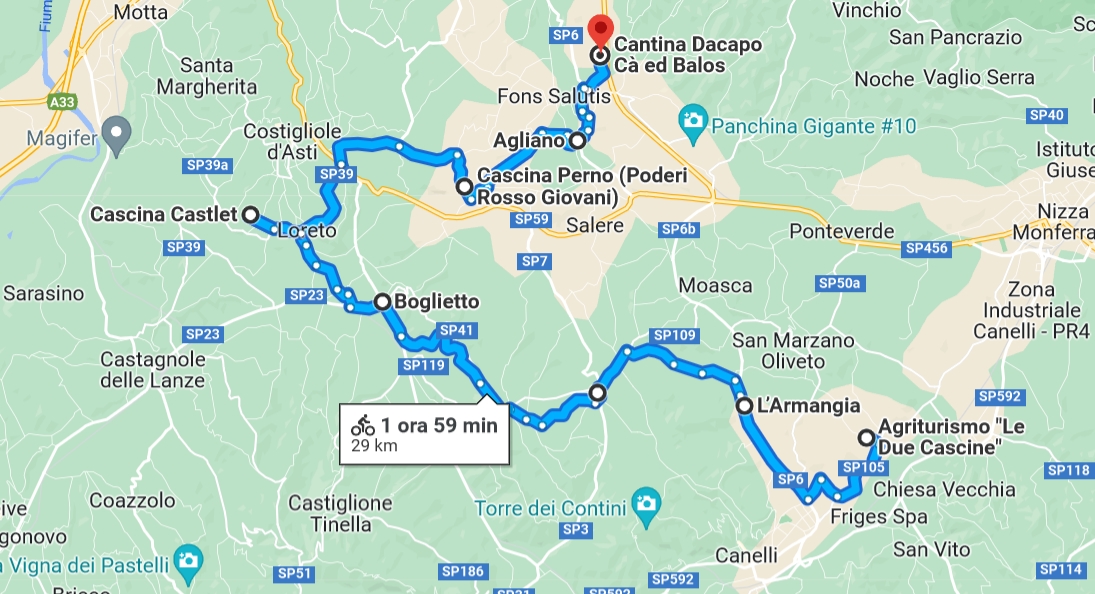
ROUTE ANALYSIS
A slightly more challenging day than the first, which had proven almost “shameful” for the paucity of kilometers. Our secret goal was to conclude the four days with a number of wines tasted higher than the kilometers covered and so far we’re fully in line with our purpose. On the second day we covered 29 kilometers, which become 35 with the 6 km made by mistake. Considering the four wineries and lunch consumed at Cascina Castlet, a wonderful snack based on fresh vegetables and “aglio free” bagna cauda, the number of wines is slightly higher, but I’ll never tell you by how much! Tomorrow is another day and another beautiful program awaits us on the road & in the cellar.