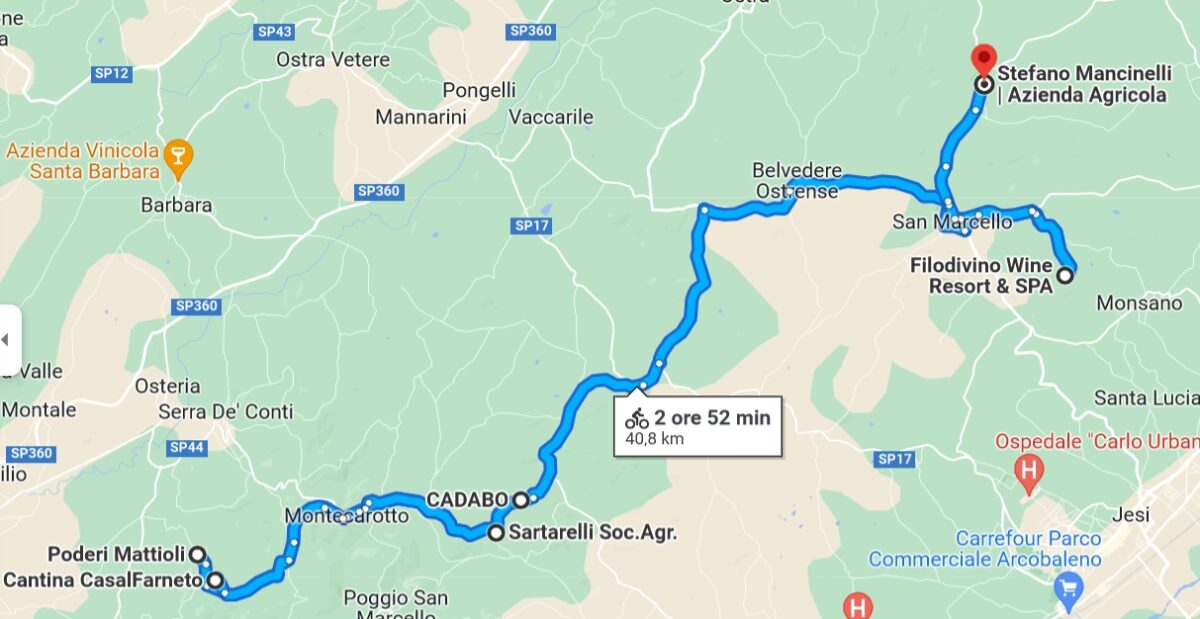
We had set the alarm but it wasn’t needed. At 7:07 the earthquake hit, 5.7 magnitude, with epicenter not far from our agriturismo. We found ourselves outside our rooms, a bit dazed but everything fine. Could have been worse, we’re ready to set off again and we think: we’re not missing anything! Breakfast with a Taiwanese guest who tells us: this happens often where we’re from, we’re used to it. Then on the saddle, descent towards the old vineyards of Umani Ronchi (they’re over 50 years old and produce a wine we told you about yesterday) and arrival after a few kilometers at Sartarelli. The sun is already high, the climate fantastic, the view from the company terrace almost moving. What more could we ask for? A blessing, perhaps…

A “BLESSED” WINE
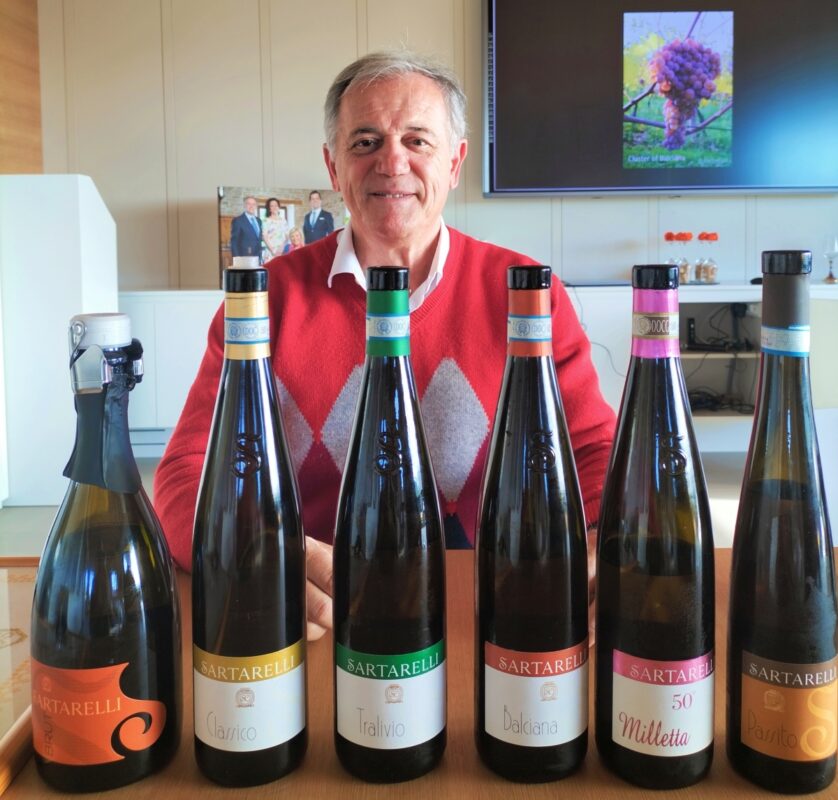
No sooner said than done, here comes the bishop of Jesi. His eminence is called Gerardo Rocconi, he’s a local (from Corinaldo, to be precise) and confirms our predisposition to blessings in the Marche region from high prelates. It happened last year in Loreto, it happens now at Sartarelli. Ritual photo with the bishop and then we “dive” into discovering the winery, which has an interesting history. Donatella Sartarelli and her husband Patrizio Chiacchiarini managed a bakery in town, they made bread and Donatella’s father worked the vineyard. With his passing, the torch passed to them and from cooperative suppliers they decided to transform into producers under their own brand. Sartarelli’s position is blessed by God and the south-facing terrace is the ideal place for tastings, which are also organized in the internal room. Moreover, with the tasting, you also do a good deed because the 10 euros paid to taste six wines go half to the cancer research association. With 20 euros you get the pairing with cold cuts and cheeses. You understand that the purpose of the Chiacchiarini/Sartarelli family with wine tourism is not to do business, it’s to make Verdicchio known, of which the company is a super specialist: in its 40 hectares of vineyards (plus 7 rented) only the prince grape variety of the area is cultivated. Also worth seeing is the small company museum with curiosities related to Verdicchio (Sartarelli’s claim is: In Verdicchio Veritas!) and worth tasting are the sweets produced for them by a local artisan. The experience is booked via email through the website or by calling the company directly.
BEYOND THE ROAD BLOCK THERE’S PODERI MATTIOLI
“You can’t pass through here,” the workers called in for the landslide tell us. The road to Poderi Mattioli, our next stop, is blocked due to the dramatic water bomb that hit Senigallia and its hinterland in mid-September. But bikes have an advantage: just get off the road, overcome the obstacle through the vineyard and the problem is solved. And in any case the workers are nice and turn a blind eye… We thus arrive in half an hour or a bit more at Serra de’ Conti at Poderi Mattioli, with the grand finale of a thrilling descent with brakes pulled because the little road is unpaved. The cellar looks brand new and indeed it’s recent: brothers Giordano and Giacomo Mattioli, with sister Letizia, built it starting from 2008 and the first vinification dates back to 2010. Before there was only the agricultural part and the Mattiolis also supplied to two cooperatives: “But it didn’t give us satisfaction,” explains Giordano. It’s a boutique winery, only 40 thousand bottles, but exports to many European countries, even to Sweden and the Czech Republic. And it’s another Verdicchio specialist, the only grape variety managed in its properties with the sole exception of a small quota of Chardonnay destined to round out the blend in its classic method. For visits it’s better to book, by phone or email, but actually you can also drop by directly and the tasting is always offered and free, while for larger groups the tasting+cold cuts pairing formula (highly recommended, lonza and salami are home made and prepared with meats from pigs raised by the neighbor) costs only 15 euros per person. Also try the oil, which however is not for sale (there are only 40 olive trees, it’s basically for personal consumption).
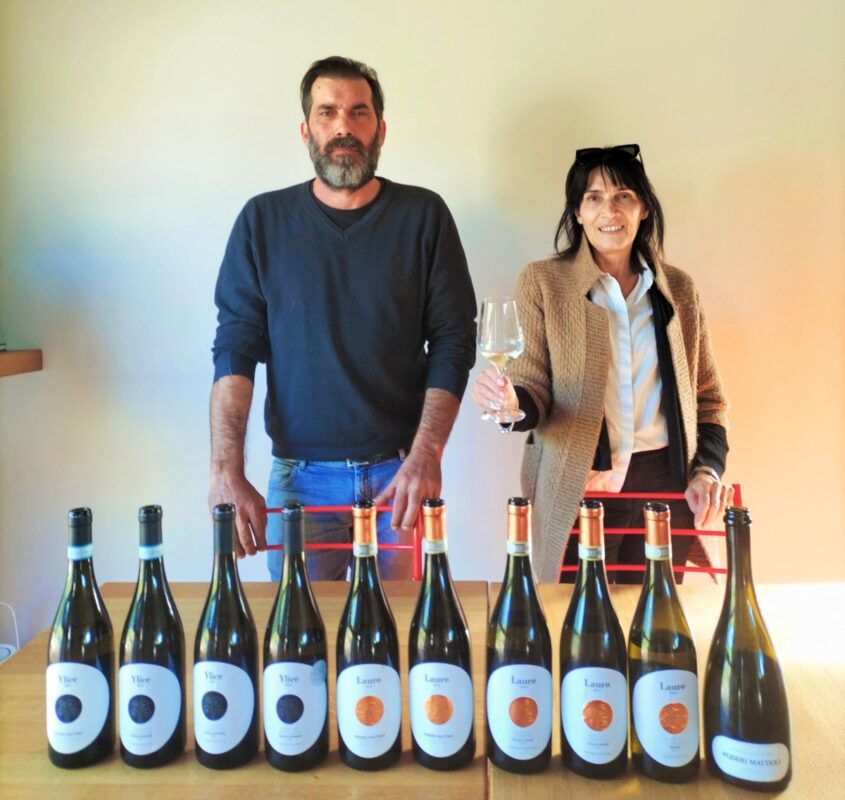
WINE AND DESIGN, HERE’S CASALFARNETO
We climb back up the dirt road and at the first junction, to the left, here’s Casalfarneto. The cellar is design-oriented, planned by architect Nazareno Petrini, who also oversaw the renovation of Casale Rita, the base of the company’s wine tourism activities. The company is owned by Paolo Togni, who purchased it in 2006: today it has 35 hectares under vine, of which 28 cultivated with Verdicchio and 7 with red grape varieties, for a total production aiming at one million bottles. Attention is very high towards sustainability themes (Equalitas certification is underway) and low environmental impact, so much so that the lands are cultivated without resorting to herbicides. The Verdicchio situation? “It’s an attractive wine, there’s great curiosity in the market, everyone asks for it and everyone wants to try it,” the owner tells us. The tastings present different formulas: base, premium and top, paired with local products. The wines are divided between those from conventional agriculture and a line dedicated to organic. Among the productions there’s also vermouth. Why visit Casalfarneto? Because it’s a winery designed “big” and with special attention to hospitality, as also demonstrated by the commendable charging station for e-bikes and electric cars.

THE WINE RESORT OF FILODIVINO
We get back on the bikes retracing the morning route. We say goodbye to the road construction workers who complain because we didn’t bring them coffee – but they would have deserved a bottle of wine too – and from Casale Rita we return towards Montecarotto to face the denomination change. A few km after the town center the junction for Morro d’Alba appears, the kingdom of Lacrima (actually, il Lacrima, rigorously masculine), which for us represents the second wine to explore in depth, after Verdicchio, in this journey. The first winery we encounter is perhaps the architecturally most beautiful we’ve admired so far: it’s Filodivino. Why this name? It reflects the story of its owner, Alberto Gandolfi, former entrepreneur in the plastic yarn sector who at a certain point in his professional path decided to sell, because he no longer recognized himself in the rules of that world, to dedicate himself to wine. From thread to wine, the estate’s name became Filodivino. The underground cellar was designed like a half barrel and the signature is by Milanese architect Cristiana Dell’Acqua. The soul of the company, from a technical point of view, is oenologist Ginevra Espositi, but Filodivino also avails itself of the consultancy of an enology big like Luca D’Attoma. Here hospitality is conceived as a true integrated activity, with seven rooms inside the “house” (actually a real wine resort) of Alberto and his wife Alida: between dining room staff and chefs dedicated to catering, a full ten people work during the good season, which begins at Easter and ends in early November. The cellar instead is open all year and offers various wine experiences bookable online starting from 20 euros per person. To complete everything, the infinity pool among the vineyards and a spa equipped with sauna and reaction tub, Turkish bath, Kneipp path, emotional showers, heated outdoor and indoor hydromassage tub with counter-current swimming, gym equipped for functional training, aerobic exercise. Among the wines whites continue to prevail, despite being at Morro d’Alba, with the prospect of reaching a balance between whites and reds, to which a part of rosés is added.

AMONG THE WILD BOARS TOWARDS MANCINELLI
Darkness has fallen again tonight, which just yesterday we had promised ourselves to avoid… But the road is relatively short (5km) to reach the finish line of the second day, which is the Stefano Mancinelli winery in Morro d’Alba. And actually there is light, because the moon magnificently illuminates the territory. We therefore climb back towards the provincial road under the lunar rays and the sensation is thrilling, then we take advantage of a tractor (here in Marche they work non-stop in the fields, even at night) that shines its headlights on us in the darkest stretch, finally we find two beautiful wild boars intent on doing something, and only they know what, in a garden along the road. Arrived at the provincial road we face the descent towards Morro and meet Stefano Mancinelli in his tasting room. We’ll tell you about the tasting experience tomorrow, because we’re already over the maximum text length! We spend the night at Le Civette, Mancinelli’s holiday home, an excellent solution to deepen the history and admire the beauties of Morro d’Alba which has a truly unique city wall in the world (with a covered walk along the entirety of the walls) and then dinner at Taverna degli Archi in Belvedere Ostrense, where we have the pleasure of meeting chef Antonio Ciotola whose enthusiasm is truly contagious, almost as much as the black truffle he proposes in his dishes. Ciotola is Campanian by origin and Marchigian by adoption, he loves Marche and loves Mancinelli’s wines, exactly like us. During the evening we’ll open a 2000 that confirms our idea of Lacrima di Morro d’Alba: the Marchigians love it young, but they don’t know what they’re missing in not having the patience to let it age. The evening therefore ends in glory and, at the end of a day in which we covered just over 40 km on our assisted pedaling mountain bikes. See you tomorrow for the last immersion in Lacrima.