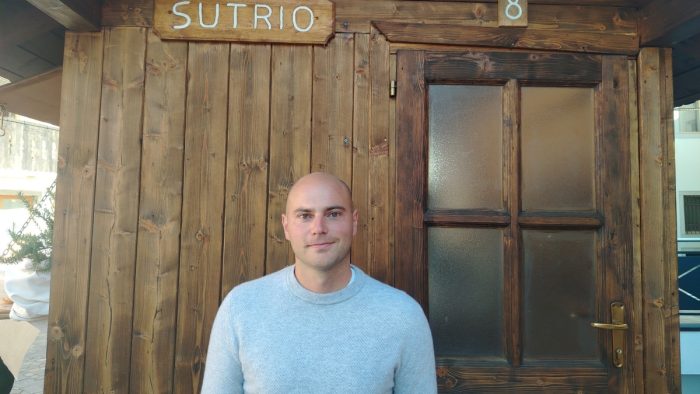
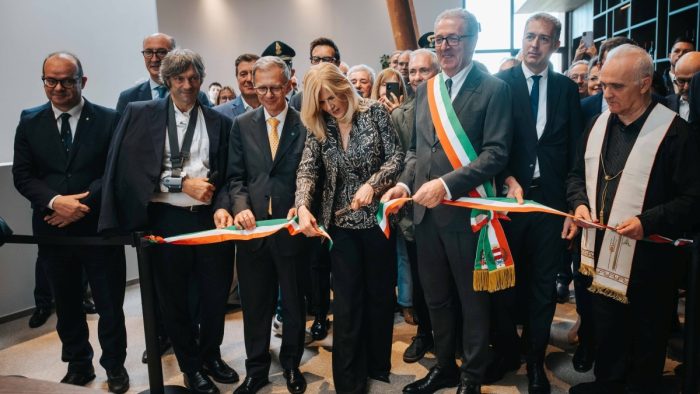
“Borders are presumptuous and don’t interrupt anything, because Italy and Slovenia are one territory. This was the message we wanted to convey“. Speaking is Federico Cleva, commercial director of Gradis’ciutta, a wine and hospitality company thanks to Borgo Gradis’ciutta which we already told you about at its official opening. This message is not at all obvious, because the borders Cleva speaks of were first a theater of war (1915-18) and then demarcation ground for the so-called “Iron Curtain”, when on one side there was democracy and on the other the communist or “Titoist” dictatorship as one might consider it. Today that Slovenia is part of the European Union, what they think at Gradis’ciutta is certainly true. And the message launched by Roberto Princic‘s company, with the Ars sine finibus project, is truly evocative.
Since early September, the vineyards have been characterized by the presence of artworks that cross, precisely, the border line and reach the property beyond the frontier, the Slovenian winery Ferdinand by Matjaž Četrtič who, together with Princic, strongly wanted this work inaugurated precisely in the year when Italy and Slovenia shared the European capital of culture with Gorizia and Nova Gorica, once divided by an urban border and now united just as the two wineries present on the Collio are united.
“The artists – Cleva tells us, whom we met in Riva del Garda on the occasion of Fine Italy, where Gradis’ciutta was present to propose its hospitality formula to international tour operators – conceived and created works dedicated to the future. They didn’t dwell on the past made of war and division. And this is a truly significant result. Now we have another art-related project in the pipeline for 2026, because we think art can be the instrument to compose new words needed to tell about reunifications or the reconstruction of shared identity“. Furthermore, the sales manager of the Gorizia company tells us, the will of Princic and the entire Gradis’ciutta team is to carry forward the just-concluded competition, consolidating it as an annual or biennial event.

Made with recycled materials, the works currently present in the vineyards are Sconfinare by Sofia Aloni and Lorenzo Lavezzo, made with used wine barrels to tell the story of the 1947 fracture when a political border divided cities, families and communities, transforming barrel staves into columns that become demographic graphics and at the same time symbolic gate capable of uniting what history has separated. There’s Spazio di vite by Chiara Andolina, Tommaso Marchesi and Simona Tessaro, a wire cage for cork stoppers on a monumental scale, intertwined with iron and vine shoots, which becomes livable architecture and symbol of conviviality and encounter. There’s Fortino e Santuario by Pietro Chiarello and Jasmin Sara Prezioso, namely a small fort that evokes military palisades but transforms them into a place of play and relationship, and a sanctuary as a gigantic blue barrel transformed into livable architecture that guards agricultural tools like religious icons, where play and spirituality coexist. There’s Mucca senza passaporto by Lili Grudina and Daniele Poli, an ancient iron gate on which a stencil of a cow divided by the border and an abstract composition evoke memory, abstraction and overcoming of borders. There’s Synergos by Nailia Khamzina and Vanessa Stefan, two intertwined bodies become vital stock at the center of the sculpture, with barrel hoops and mosaic of colored glass that filter light, symbol of coexistence and bridges between peoples. There’s the work that won the jury prize, Scritto nelle pietre by Juliana Florez Garcia, Gloria Veronica Lavagnini and Tajda Tomšič, an arch and wall that recall the former border, made with marl, stone and golden inserts, transforming the historical wound into passage and threshold toward a shared consciousness. Finally, on the occasion of the inauguration ceremony of the cross-border theme park among the vineyards, the installation So(g)no by artist Marco Nereo Rotelli was also inaugurated, created with the contribution of Prof. Riccardo Valentini, composer and radio host Alessio Bertallot, Slovenian poet Aleš Šteger, Italian poet Valerio Magrelli and Friulian artist Giorgio Celiberti, transforming the vineyard space into an immersive journey of light and poetry, inviting visitors and communities to share a sensory and reflective experience.
Meanwhile, the wine tourism experience of Borgo Gradis’ciutta grows and not just thanks to art. “We’ve increased the number of experiences, with increasingly tailor-made work for guests”, Cleva specifies. Among the new experiences launched by Gradis’ciutta stand out the creation of one’s own blend using wines produced by the company, educational harvest, territory tours with vintage Vespa or e-bike. These formulas add to the consolidated offering of tastings and degustations, cooking classes, vineyard picnics and everything that can be booked online directly from the company website, including the hospitality part with 9 rooms and three apartments available for guests.