Let’s talk about Orvieto and immediately try to frame the key elements of this territory.
First element: Orvieto equals white wines, devastated by the policy of maximum discount at supermarkets (where sometimes you can find bottles at 1.99 euros) because, as someone still says for foreign markets, Orvieto is the discount of Chianti. Which means: I’ll make you pay full price for Chianti and in exchange I’ll also give you Orvieto, sell it however you want… A small anecdote, this, that summarizes the assisted suicide of a denomination dominated by bottlers who don’t care about the territory’s growth but only want to maximize their sales. Yet we are in Orvieto, in the green heart of Italy, a jewel-city with a unique cathedral in the world. And which would have much to say about wine, if only it decided to focus on quality. In our journey, overcoming prejudices – and after all, what are journeys for if not to understand things directly? – we met a group of producers, who call themselves ORV-Oltre le radici della vite (but then the acronym becomes the initial of Orvieto), composed of five companies that are joining forces precisely to relaunch Orvieto’s image, communicating the complexity and potential longevity of their wine of choice. And telling about a territory worth experiencing, starting from its uniqueness. And this allows us to get to point 2.
Second element: the caves. Already in ancient times it was said that “the good wine of Orvieto can only be drunk in Orvieto”. And not because dishonest innkeepers watered it down on the journey to Rome, but because in Orvieto there were natural cellars, carved in tuff, where conservation took place at a stable temperature all year round. So the wine was particularly good because it matured in its natural environment. After all, we know, even today wine drunk in the territory where it’s born is always better than elsewhere. The caves are found everywhere and are Orvieto’s trademark: there are some right in the center, others in cellars scattered in the countryside. Visit them, because they are the genius loci and then, if you have a heart of (volcanic) stone and easy social media habits, know that they are also super instagrammable. They bring likes.
Third element: longevity. That of the wines, of course. At one point during the evening spent with the ORV producers, one of them said: “Where do you try a vertical like this? At most in one, two Italian denominations”. And he was right! On the table, among the five vintage wines that each of them had brought, there was a 1998 vintage, harvest dating back 24 years ago, white wine! Tasting is not my job, but my thoughts on possible white wine comparisons immediately went towards Marche (Verdicchio di Jesi or di Matelica). We’re not talking about metodo classico sparkling wines because that’s another world. But what surprised me most is the benefit that time brings to Orvieto doc: it’s as if its somewhat aggressive structure gradually becomes more docile. “Orvieto is a diesel” another producer promptly added. And I’ll say another thing: Orvieto is an honest wine, because it blatantly reflects the quality of the vintage. Or perhaps they are honest, the producers, who don’t resort to tricks and offer us only what nature has been able to express.
Having set the three stakes, let’s go discover our five companies all worth visiting. Not before adding the last consideration: the 1.99 euro per bottle Orvieto will continue to exist, on the shelves of large retailers, because the territory is not yet ready to give itself a quality strategy (which the system, starting from the Consorzio di Tutela, should implement). How do you get out of it? Go take a trip to Orvieto, visit these companies and tell everyone that here there are also those who know how to do things properly.

1. SERGIO MOTTURA
The symbol of this winery is a porcupine, present on the label. Why the porcupine? Because Mottura is a pioneer of organic agriculture (conversion started in 1991, certification since 1996) and when he abandoned the shortcuts of “conventional” treatments, porcupines returned to his vineyards. The company produces Orvieto doc but geographically is in Lazio, because it’s located in the municipality of Civitella D’Agliano. Worth the trip for the visit to the historic cellar, dating back to 1600: the most beautiful photo you see below is that of the metodo classico bottles with natural molds. Giuseppe Mottura personally handles hospitality (in addition to doing a thousand other things, including being mayor of Civitella) together with agronomist Beatrice Scorsino: you book by email or phone, it costs 25 euros per person including tasting and lasts a full two hours (eight wines). Since 1992 the company has had a hotel and agriturismo, La Tana dell’Istrice, with twelve rooms but currently closed for renovation. When it reopens, don’t miss the main dish: roast goose paired with 100% Grechetto “Latour a Civitella”.

2. CANTINE NERI
Here we return to Orvieto and the place is truly evocative. The barriques are kept in an ancient Etruscan tomb that then, over the centuries, was also used as a refuge by pilgrims traveling from the via Romea to the Francigena. Neri’s current property was indeed a reference point and stop because it’s located exactly in the center of three churches: San Pietro e Paolo, Santa Maria delle Grazie, Santa Maria del Piano. Managing the company is Enrico Neri, who had started as a grower and supplier but then wanted to take a step further, becoming a winemaker since 2006. Hospitality is based on different formulas: starting from the tasting of three “Vista Rupe” wines offered at the price of 15 euros to reach 50 euros for the Orvieto vertical called “Sulle orme dei templari” (with paired dishes) to finally arrive at a proposal that combines the company’s wines with blind tastings of other wines that Enrico likes (70 euros). The agricultural company doesn’t just make wine: there are Livorno laying hens and Zackel sheep, endangered species.
3. PALAZZONE
Giovanni Dubini introduces himself with this phrase: “Elio Altare, my mentor, told me: we don’t produce wine, we produce pleasure”. Elio Altare was one of the “Barolo Boys” and from his association with him and with the other Barolo pioneers in the world (Dubini told us hilarious stories that we won’t reveal even under torture, but with a good glass we might be corruptible) you can understand his passion for quality. And not only in wine. His locanda Palazzone is a little jewel. It was part of a much larger building, probably a pilgrims’ refuge, that became a warehouse falling to pieces. The recovery was exemplary (“140 people worked on it” he specifies) and today offers seven tastefully furnished rooms and a 100% local products breakfast. At that point, since the recovery had been completed, he convinced his wife Cristiana to leave teaching and take over management, a convincing that Cristiana still hasn’t forgiven her husband for, but that’s another story… The point of staying at Palazzone is to live the history of the place and become a bit part of the family with Cristiana, with son Pietro, with the cats and with Duccio the dog. “The future of my company and of the territory will be the union between wine and tourism” says Giovanni. Palazzone’s wines? 130 thousand bottles a year, 50 thousand of which are their flagship wine, Terre Vineate. Buy them, put them in your cellar and forget about them for a long time… Then we’ll talk about it again!
4. LE VELETTE
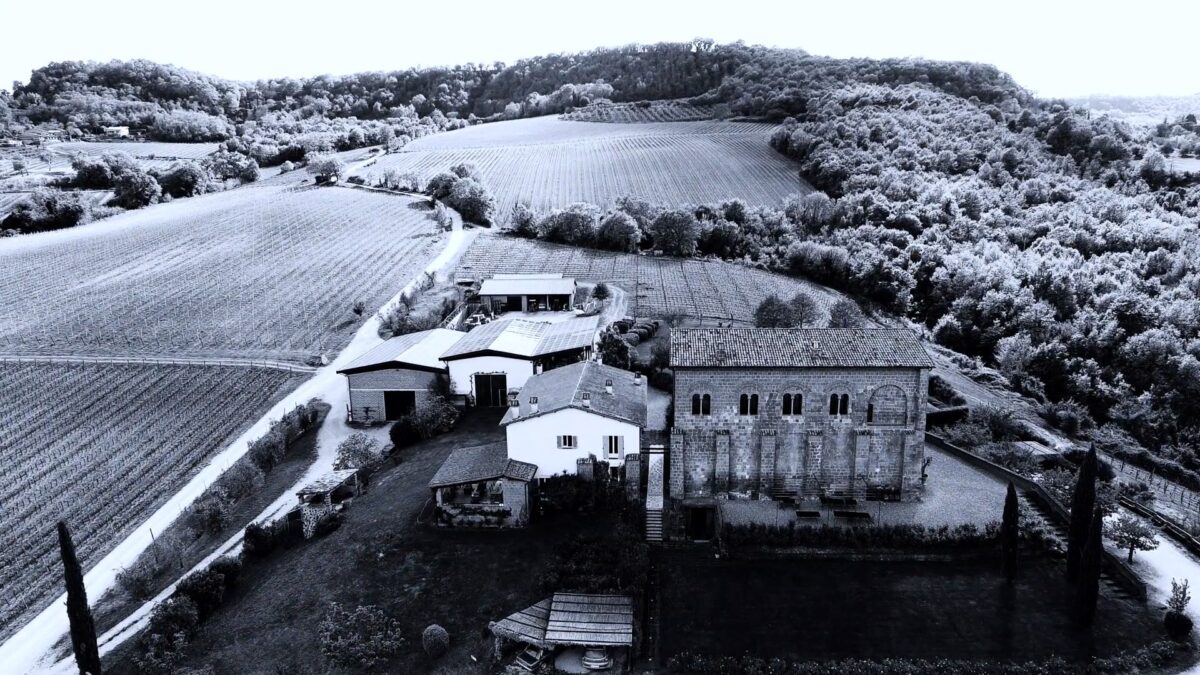
This company has written pages of history because it has been multi-awarded since the nineteenth century, when it was still called Fratelli Felici and produced rather strange wines for the territory (we even noticed a Tokai label). Corrado Bottai represents the sixth generation of the founding family and speaks of his father as the architect of Le Velette’s relaunch, starting from 1968. But he also contributed his part, recovering four farmhouses left free at the time of sharecropping and transforming them into accommodation: they’re called Le Lodole, Belvedere and Palazzina, complete with swimming pools for the beautiful season. “Our idea of wine tourism is based on tasting for small groups and making available a house in the countryside, without preparing breakfasts and without making beds because we’re not hoteliers but we’re winemakers” Bottai tells. Tasting is organized in the appropriate room equipped for small groups, while for larger ones they move inside the manor villa present in Le Velette property. Bottai has seen a lot in these years, and would have had every reason to be suspicious about possible actions to relaunch the denomination, but he hasn’t lost hope and especially hasn’t lost energy. “Orvieto today has no value, in wine, because it didn’t want to tell its own value. And its own value is the territory”. It’s never too late.

5. MADONNA DEL LATTE
And here’s the most incredible example of how it’s never too late and how sometimes ideas to create value come from distant places… Leon Zwecker, as you can guess from the name, is not exactly Orvieto doc. His family invested in 2000 by purchasing a ruin and abandoned land, with the idea of doing agriculture and wine. He, German from Bavaria, studied enology in Austria, worked in Sonoma (California) and Marlborough (New Zealand) before dedicating himself, since 2008, to the family estate. “At the beginning I thought: I’ll do everything except Orvieto, because it was a wine that didn’t interest me. Then it fascinated me and today I make 3 thousand bottles out of 20 thousand”. The passion came to him along the way, comparing himself with other producers and managing to understand the great diversity of the denomination’s soils, which give life to different and complex expressions of Orvieto whites. But let’s get to the point: what is Zwecker’s innovative contribution. He does 100% direct sales, of which 60% at the winery and 40% with home delivery. His bottles don’t pass through the hands of any distributor or agent. How does he do it? He used digital tools (especially newsletters) to make Madonna del Latte known to a rather broad community and in winter, for a month, he leaves with his partner Ruta for the United States and organizes dinners at clients’ homes bringing his wines from Italy and having the hosts’ guests taste them, so then word spreads… Only one thing remains to understand: how does he sell 60% of his production directly at the company? Leon answers us: “Go look at TripAdvisor and search ‘things to do in Orvieto’…”. We do it and in first place we find: visit Madonna del Latte. For the record, the Cathedral is four positions behind.