

Our destination is Valle Telesina, in the province of Benevento, to discover authentic flavors and immerse ourselves in places still untouched by mass tourism. We’re heading to Guardia Sanframondi, headquarters of Cooperativa Agricola La Guardiense, where the Janare wine project took shape. Here tradition goes hand in hand with good food culture with a view to developing and revitalizing the territory.
THE WITCHES HAVE RETURNED
The first thing to know is that Janare is the name given to the witches who, according to peasant tradition, inhabited the woods and snuck into stables at night to steal mares. The second thing to know is that La Guardiense offers “volcanic wines” in the new Anima Lavica line, within the broader project called Janare.
We find ourselves in the wine heart of Campania, thanks to the presence of extremely fertile soil and the valorization and innovation work carried out by this cooperative founded in 1960 by thirty-three members, which today includes about a thousand farmers who directly cultivate over fifteen hundred hectares of vineyards.
Annual production stands at around two hundred thousand quintals of grapes, from which derive the still and sparkling wines of the Anima Lavica line (the terroir is entirely volcanic) and those of the Cru del Sannio line, produced with itinerant zoning that guarantees quality levels above the territorial average precisely because only the best vineyards are identified year after year.

HOSPITALITY AT THE TABLE
Actually, our journey is only “in words” because we find ourselves at 28 Posti, a contemporary Mediterranean cuisine restaurant in Milano where you can taste dishes prepared by the talented young chef Marco Ambrosino. And the words are those of a pleasant chat with Marco Giulioli, Head Oenologist of the Campanian company, while we taste a glass of Spumante Brut di Falanghina Anima Lavica. The color is straw yellow with green reflections and floral scents of orange blossom completed by flint and yeast nuances. This is an elegant, savory, soft and very persistent sparkling wine that’s ideal for aperitifs (as in our case!), but also throughout meals with appetizers, first courses or fish dishes, or white meats.
The conversation starts from the project’s birth three years ago, thanks to his discovery of a soil zoning map of Valle Telesina, and focuses on one of its strengths: hospitality.
“The project – Giulioli tells us – was born with a precise idea, which is to valorize the very essence of our cooperative, which boasts important numbers in the context of inner Sannio. Our members are cultivators of culinary traditions and hospitality. We’re in Southern Italy, in Campania, where the propensity for welcoming is at home. Given these characteristics, we created a restaurant within the company that works exclusively by reservation for groups. Currently we don’t welcome individual visitors, but probably we will in the future. In the restaurant, dishes are prepared by our associates, who offer a menu rigorously tied to the territory. It’s traditional cuisine that normally isn’t found in restaurants“.

HIGH-LEVEL OFFERING
We find ourselves in a geographical area where the food and wine offering is high quality, and could serve as a catalyst for tourism attentive to the most authentic aromas and flavors to taste at the table. “In Telese, which is not far from our headquarters, out of eight thousand inhabitants there are two starred restaurants. One with one star and the other with two Michelin stars. Receiving such prestigious stars, in the context of inner Sannio, is the fruit of an important gastronomic culture. We started a short time ago, but there have already been significant results“.
The keyword is valorization of the lands and their extraordinary differences, such as the well-defined volcanic soil that gives a strong identity to grapes and wines. An example is the Falanghina “Anima Lavica” 2021, Falanghina del Sannio DOP that carries notes of broom and linden, and citrus nuances, which we taste paired with trottole cooked in fish bone broth, aromatic herb sauce, chopped shells and fig oil.
This wine is paired with fish or vegetable dishes, but also to enhance Campanian buffalo mozzarella and soft cheeses. And naturally it finds its place on the table of the Campanian company’s restaurant, based on the dishes being served.

ODE TO TRADITIONAL CUISINE
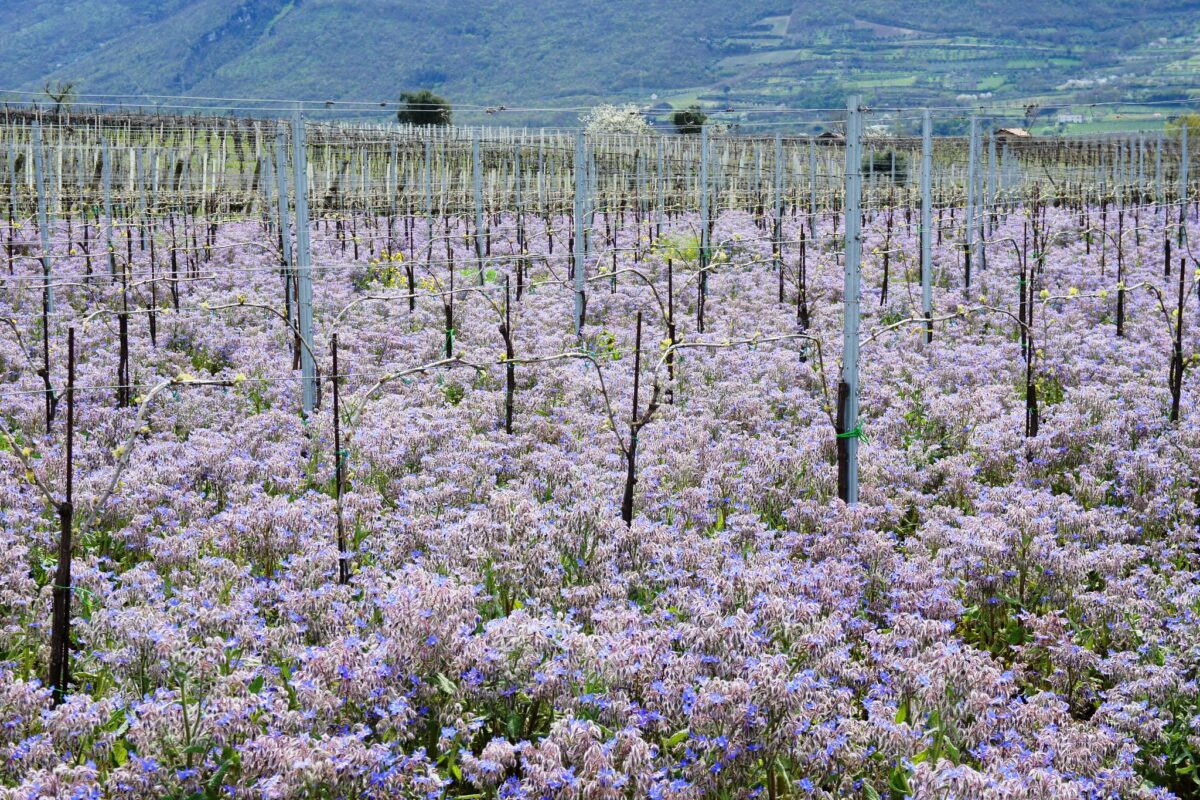
“Our female members propose traditional dishes, like pasta made with borage, a wild herb that grows in our valley and is added directly to the dough. They also prepare an extremely particular pasta. In dialect it’s called mije fant, and it’s really evocative to witness the preparation procedure. It’s worked by two people, starting by creating a plane of raw flour. One person sprays water drops that create lumps as they fall, the other person mixes these lumps that assume various sizes. You get a sort of couscous that’s seasoned with vegetables available according to season. We must also remember that in peasant culture nothing is thrown away, so it happens that flour residues from preparing another dish are recovered, avoiding waste. Naturally everything is very fresh and pairs perfectly with our whites, creating harmony between the dish, the tradition we want to preserve and the wine which is exceptional“.
The project’s peculiarity is that it makes traditional cuisine dishes and the wines served in pairing a unique experience, difficult to replicate in other restaurant contexts. “There’s another dish we offer among the signature dishes of our winemaker cooks, it’s panzetta chiena. In peasant tradition, meat was something difficult to obtain due to cost. It was essential to eat it to sustain the family, but the quantity available compared to mouths to feed was meager. So the meat was stuffed with bread to have psychological satisfaction, since the portion appeared larger“.

APPOINTMENT AT VINALIA
Good food meets good wine and becomes a source of inspiration to attract more and more curious visitors and enthusiasts, but it’s essential to have an adequate container like a well-organized event. In Guardia Sanframondi, from August 4 to 10, Vinalia will take place, which has had extraordinary evolution over the last fifteen years. “Territorial companies let people taste their products, but there are also internationally renowned artists. In unsuspected times, and then returned two years ago, Jorit exhibited. So there’s the cultural part and that linked to wine, and there are many companies that can make known what they produce. And naturally there’s gastronomic variety. Inside the castle, showcookings with local restaurants that showcase their abilities in preparing dishes go on stage for seven days. And obviously there are pairings of various recipes with wines“.
NAPOLI ISN’T FAR
We discover that we move in a gentle and welcoming landscape, dotted with vineyards, but there’s also a mountainous part that’s almost unexpected and allows you to climb over a thousand meters and enjoy extraordinary panoramas. “We’re working hard to ensure that tourists who go to Napoli and the Costiera Amalfitana can find time to break away and head to the hinterland to spend a day visiting beautiful places and tasting typical products. The invitation is to immerse yourself in a completely different context. Just think of the soil colors, which are an authentic mosaic because there isn’t a single soil type. Thirty-nine thousand years ago the Campi Flegrei had an explosion that devastated Campania, but not only. Monte Taburno acted as a shield so the volcanic part is limited to the western area. We have volcanic soil, but also alluvial and calcareous-clay soil, with marls throughout the hilly part. And then we have thermal baths above the municipality of Telese that are very particular because they have cold sulfurous waters. The icy sulfurous water pools have extraordinary properties for the skin, and refresh incredibly“.
Our conversation concludes talking about the bridge over which the famous Carthaginian commander Hannibal would have passed with his elephants during the Second Punic War. Thus takes shape a context rich in art, history and culture (also to bite and drink), that makes you want to set off on a journey.


